
Blog
Top 5 Alternatives to Mass Produced Sofas in 2026
Nov
Last Updated: November 5, 2026
Quick Summary
The best alternatives to mass produced sofas are pieces made by hand in smaller runs, where the maker controls the frame, joinery and upholstery. Options covered include specialist British handcrafted sofas, traditional Chesterfields, made-to-order sofas, solid hardwood frames and durable leather sofas chosen for longevity.
- Check the frame first: solid hardwood with mortise-and-tenon or doweled joints points to a handmade build.
- Ask a maker to name the frame wood and say whether it is solid or engineered.
- Traditional Chesterfields use hand-tied springs and layered fillings that can be repaired and replaced.
- Made-to-order sofas let you specify width, depth, seat height and fabric before the piece is built.
- Compare cost per year of use rather than the purchase price alone.
Table of Contents
- What Counts as a Mass Produced Sofa, and What Are the Alternatives?
- Alternative 1: Handcrafted Sofas from a Specialist British Maker
- Alternative 2: Traditional Chesterfield Sofas
- Alternative 3: Made-to-Order Sofas with Your Own Dimensions and Fabric
- Alternative 4: Sofas Built Around a Solid Hardwood Frame
- Alternative 5: Leather Sofas Chosen for Longevity, and How to Care for Them
- Choosing the Right Alternative for Your Living Room and Budget
- Frequently Asked Questions
What Counts as a Mass Produced Sofa, and What Are the Alternatives?
Mass produced sofas are built on production lines in large volumes, often with engineered frames, foam-and-fibre fillings and fabrics chosen for cost. To see how two retailers compare on craftsmanship, customisation, and value, read the side-by-side comparison. The alternatives are pieces made by hand in smaller runs, where the maker controls the frame, the joinery and the upholstery. Read more about what handcrafted British furniture offers compared with factory pieces. Our view is that the difference shows most in the parts you cannot see on a showroom visit.
How to Tell a Mass Produced Sofa from a Handmade One
Start with the frame. Ask what it is made from and how the joints are put together, since that is the quickest way to tell mass produced sofas apart from handmade ones. Engineered boards and corner blocks held with staples suggest mass production, while a solid hardwood frame with mortise-and-tenon or doweled joints points to a handmade build. For a deeper explanation of why handcrafted furniture outlasts factory pieces, see our guide. Next, check how the cushions are filled and whether the springs are hand-tied or sprung in a machine-stitched grid. Finally, look at the fabric and seams. Straight, even stitching is standard in factories, but a specialist maker will usually explain how the pattern was matched and how the seams were finished. If a retailer cannot answer these questions in plain terms, treat that as a warning sign.
Alternative 1: Handcrafted Sofas from a Specialist British Maker
A specialist British maker is the closest alternative to a mass-produced sofa in terms of everyday buying. The work is done in small teams, and the emphasis is on the frame and upholstery rather than speed. The trade-off is a higher initial investment than factory-line furniture, and lead times are longer. For most buyers, that cost is spread across many years of use.
Alternative 2: Traditional Chesterfield Sofas
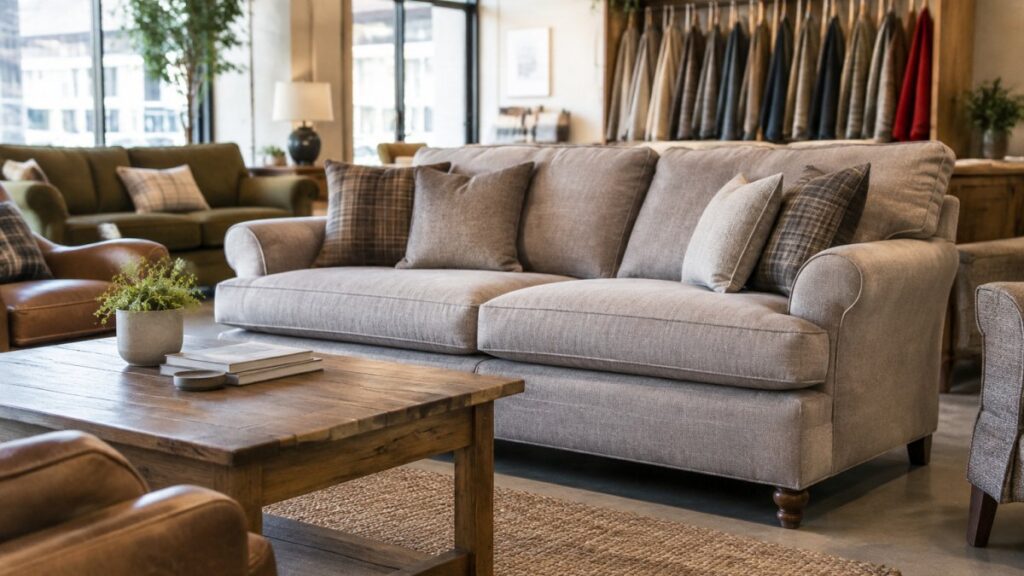
A traditional Chesterfield is a deep, buttoned design with rolled arms of equal height, built on a sprung base and filled in layers. It earns a place on this list because its construction is well documented and, crucially, repairable: the frame, springs and fillings can be opened up and replaced by a competent upholsterer rather than the whole piece being discarded. That is the opposite of the sealed, glued-together construction common in mass-produced sofas.
What to check in the build
Ask how the base is sprung. A traditional Chesterfield uses serpentine or coil springs that are hand-tied or hand-lashed to the frame, which spreads load and can be retied later. A machine-stitched sprung grid is faster to assemble but harder to repair. Ask what the fillings are: horsehair and cotton layered over the springs hold their shape and can be topped up, while a single block of foam is cheaper but compresses over time. Check the buttons too, deep buttoning pulls the filling tight and is a sign of hand-upholstery, but it also means the seat needs occasional attention to keep the buttons secure. Once the frame, springs and fillings are sound, durable upholstery fabrics help the sofa withstand daily wear without compromising its character.
The practical trade-offs
A full-size Chesterfield is heavy and bulky, and its rolled arms eat into usable seat width, so it can overwhelm a small room. Lead times from a specialist maker are longer than off-the-shelf buying, and the deep buttoning collects dust, so it needs more frequent vacuuming than a plain sofa. For renters or anyone likely to move soon, the weight and size are a genuine consideration.
If you want the look without a full bespoke build, look for a maker who offers scaled-down arms, a choice of leather or fabric, and a written specification of the frame, springs and fillings.
Alternative 3: Made-to-Order Sofas with Your Own Dimensions and Fabric
Made-to-order sofas let you choose the exact width, depth, seat height and fabric before the piece is built. This matters if your room has an awkward alcove or you want a sofa that sits flush against a wall. The process takes longer than buying off the shelf, so plan around it. Ask for a written specification that lists the frame material, the fill, the fabric grade and the delivery window. A reputable maker will provide this without fuss.
Alternative 4: Sofas Built Around a Solid Hardwood Frame
The frame is the part of a sofa that decides how long it keeps its shape, yet it is the part most buyers never see. This section gives you a way to compare frames on evidence rather than on the finish of the arms, an angle most roundups skip.
Why the frame matters more than the filling
A sofa’s cushions and covers can be replaced; a twisted or cracked frame usually cannot be saved economically. Learn what sets solid wood frames apart from engineered alternatives and how to identify one. Engineered boards and stapled corner blocks are serviceable for light use, but they resist repair. A solid hardwood frame, beech and ash are common choices, with properly cut joints holds its geometry under daily load and can be taken apart and reupholstered later. That repairability is what turns a higher purchase price into a lower cost per year of use.
How to verify a frame before you buy
Ask three plain questions and insist on plain answers:
- Which wood, and is it solid or engineered? A maker should name the species and say whether the frame is solid throughout or mixed with board.
- How are the joints made? Mortise-and-tenon and doweled joints are the benchmarks; staples and screws alone are a warning sign.
- Can it be reupholstered? A frame designed for later reupholstery will have accessible fixings and a maker willing to service it.
Watch out: a retailer who cannot name the wood or describe the joint is usually selling a frame you will not be able to repair.
The trade-offs
Solid hardwood frames are heavier, which matters if you move often or live upstairs, and they cost more up front than engineered alternatives. Lead times are longer because the frame is built rather than assembled from stock. For families, renters planning to stay put, and anyone buying once rather than repeatedly, the repairability usually outweighs the weight and the wait.
The table below sums up the frame checks and trade-offs covered in this section.
| Check or trade-off | What to look for | Note |
|---|---|---|
| Frame wood | Solid hardwood such as beech or ash | Ask whether the frame is solid or engineered |
| Joinery | Mortise-and-tenon or doweled joints | Staples and screws alone are a warning sign |
| Reupholstery | Accessible fixings and maker support | Allows the frame to be serviced later |
| Weight | Heavier than engineered frames | Matters if you move often or live upstairs |
| Lead time | Longer than stock frames | Frame is built, not assembled from stock |
| Cost | Higher up front | Lower cost per year of use if repaired |
Alternative 5: Leather Sofas Chosen for Longevity, and How to Care for Them
Leather can age well if you choose the right grade and look after it. Full-grain and top-grain leathers develop a patina rather than cracking quickly, while lower grades can split with regular use. Dust the sofa regularly, wipe spills promptly, keep it away from direct heat and sunlight, and condition the leather according to the maker’s guidance. A little care each month does more for lifespan than any single product.
Choosing the Right Alternative for Your Living Room and Budget
There is no single best answer. Before committing, see whether a Tetrad sofa justifies its cost in terms of handcrafted quality, durability and warranty. A family with children and pets may value a durable, easy-clean fabric and a solid frame more than a leather finish. Someone with a specific room layout may need made-to-order dimensions. Budget matters too, and the honest comparison is cost per year of use rather than the purchase price alone. We recommend starting with your room, your daily use and your maintenance tolerance, then narrowing the list to two or three makers you can speak to directly.
Frequently Asked Questions
What are the alternatives to mass-produced sofas?
The main alternatives are handcrafted sofas from a specialist maker, traditional Chesterfield designs, made-to-order sofas built to your dimensions, sofas with solid hardwood frames, and leather sofas chosen for longevity. Each trades some speed and convenience for better build quality. Tetrad sofas are handcrafted British furniture. Pricing depends on the piece, fabric or leather, and delivery, so check Tetrad’s website or request a quote for current figures.
Are handcrafted sofas better than mass-produced sofas?
Handcrafted sofas are usually built with more attention to the frame, springing and finishing, which tends to improve how they hold their shape over time. Mass-produced sofas can be comfortable and well designed, but they are more often assembled with faster methods and lighter materials. The difference is clearest in the frame and the upholstery joins. When comparing, ask about the frame material, how the seat is sprung and whether the maker offers repairs or reupholstery later.
How long can a well-made sofa last?
A well-made sofa with a solid hardwood frame, quality springing and good upholstery can last many years, often longer than a typical mass-produced sofa, though exact lifespan depends on use, cleaning and the materials chosen. Leather tends to age gracefully, while fabrics vary by weave and fibre. Ask any maker what their frame is made from and whether parts can be replaced, as repairability is a strong indicator of how long a sofa will serve you.
How do I care for a leather or fabric sofa?
For leather, dust regularly, wipe spills promptly with a damp cloth, and use a leather conditioner suited to the finish a few times a year to keep it supple. Keep leather away from direct sunlight and radiators, which can dry and fade it. Fabric sofas benefit from vacuuming with an upholstery brush, spot-testing any cleaner on a hidden area first, and rotating cushions to spread wear. Follow the care label supplied with your sofa, as it reflects the specific materials used.

