
Blog
Why Choose Solid Wood Sofa Frames
Sep
Table of Contents
- Why Solid Wood Sofa Frames Matter for Long-Term Investment
- Hardwood vs Softwood Sofa Frames: Which Delivers Better Performance
- Is Solid Wood Better Than Plywood for Sofas
- How to Check Sofa Frame Quality and Construction Methods
- Resistance to Warping, Sagging, and Long-Term Performance
- Sustainability and Repairability: Why Frame Quality Matters Beyond Price
- Frequently Asked Questions
Last Updated: September 24, 2026
Why Solid Wood Sofa Frames Matter for Long-Term Investment
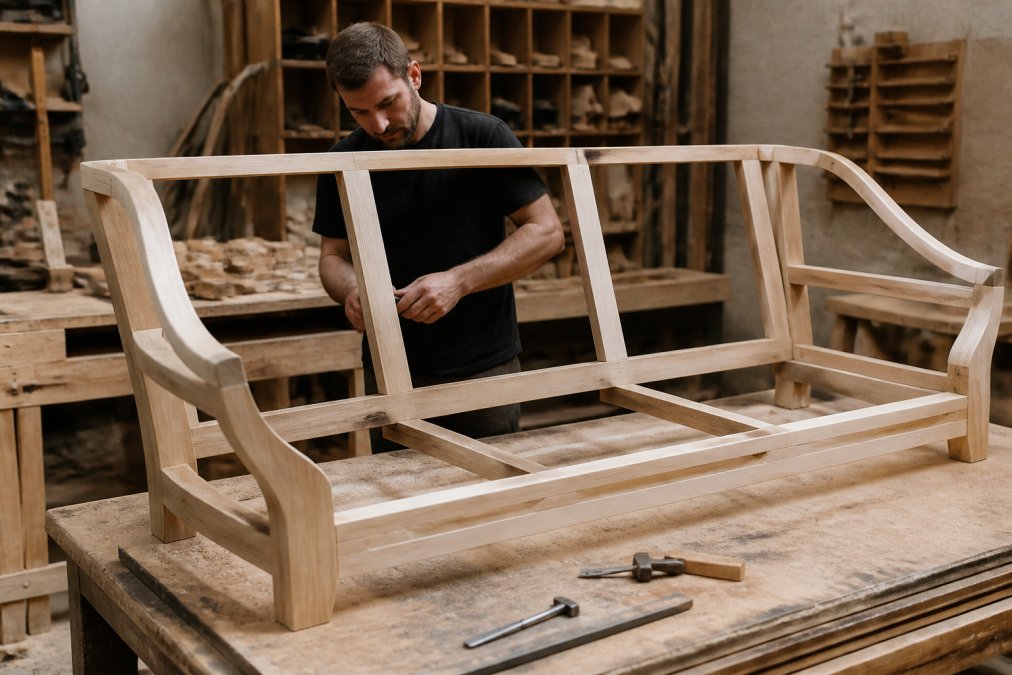
A quality sofa frame is the foundation of furniture that lasts decades rather than years. When you invest in a piece from Tetrad sofas, you’re choosing construction methods that prioritize longevity. The frame determines whether your sofa will develop wobbling, sagging, or structural failure, problems that no amount of premium fabric can fix once they’ve begun.
Most buyers overlook the frame, a costly mistake. A beautiful sofa with a weak frame becomes a regret within five years. Solid wood sofa frames resist the wear that engineered alternatives cannot withstand, supporting weight consistently and remaining stable through decades of use.
The difference is visible in joint construction, wood selection, and load-bearing response.
Hardwood vs Softwood Sofa Frames: Which Delivers Better Performance
Hardwood Construction and Structural Integrity
Hardwoods like oak, beech, and ash have denser grain structures that resist compression and movement. When bearing weight, hardwood fibres compress slowly and recover, maintaining their original shape across thousands of use cycles.
Hardwood frames excel at load-bearing capacity, settling minimally in the first year then stabilising. Softwood frames compress more readily and may never fully recover their original dimensions.
Hardwood construction requires more skilled labour and higher material prices, but justifies the investment for sofas designed for longevity.
Softwood Benefits and Limitations
Softwoods like pine and spruce are cheaper and easier to mill, but have notable limitations for long-term performance.
Softwood frames sag noticeably within 3-5 years of regular use and are susceptible to moisture-induced swelling and warping, making repairs difficult.
Softwood suits guest bedrooms or occasional-use pieces only; for daily living room use, it’s a false economy.
Is Solid Wood Better Than Plywood for Sofas
Solid wood provides the structural backbone, rails, legs, and corner blocks that bear weight and resist racking. Plywood and particle board cost less but lack durability.
Plywood and Particle Board: Cost Versus Durability
Plywood’s glue joints are its weak point; humidity causes delamination over time. Particle board, made from wood chips and adhesive, is even more vulnerable.
Budget sofas using plywood and particle board develop wobbling within 2-3 years as the particle board crumbles under load.
Solid wood frames remain stable because the wood itself is load-bearing, with no glue joints failing or layers separating.
Load-Bearing Capacity and Frame Stability
A properly constructed solid wood frame offers significant support; plywood frames offer less.
Solid wood frames resist racking (twisting from uneven weight); plywood frames lack tensile strength.
How to Check Sofa Frame Quality and Construction Methods
Identifying quality requires knowing what to look for and what questions to ask.
Joint Construction: Why Mortise-and-Tenon Joints Outperform Alternatives
The joints that connect frame pieces determine whether the frame will remain square or develop play and wobbling. This is more critical than the wood species itself. Mortise-and-tenon joints are the gold standard because they create a mechanical interlock that resists stress from every direction, not just compression, but shear and tension forces that occur during daily use.
In mortise-and-tenon construction, a projecting piece (tenon) fits into a cavity (mortise) so tightly that the joint resists movement before glue is applied. The joint’s strength comes from geometry, not adhesive alone, and can withstand decades of stress.
Dowel joints rely almost entirely on glue for strength. Over time, wood movement and repeated stress cause dowels to loosen, developing noticeable play within 5-10 years.
Double-dowel construction improves performance but doesn’t match mortise-and-tenon strength; pocket-hole joinery is weaker still.
The best frames use mortise-and-tenon joinery throughout the frame, with additional corner blocks at every stress point. Ask retailers directly: “What joinery method is used to connect the frame rails and legs?”
Corner Blocks and Reinforcement: The Difference Between Stable and Wobbly Frames
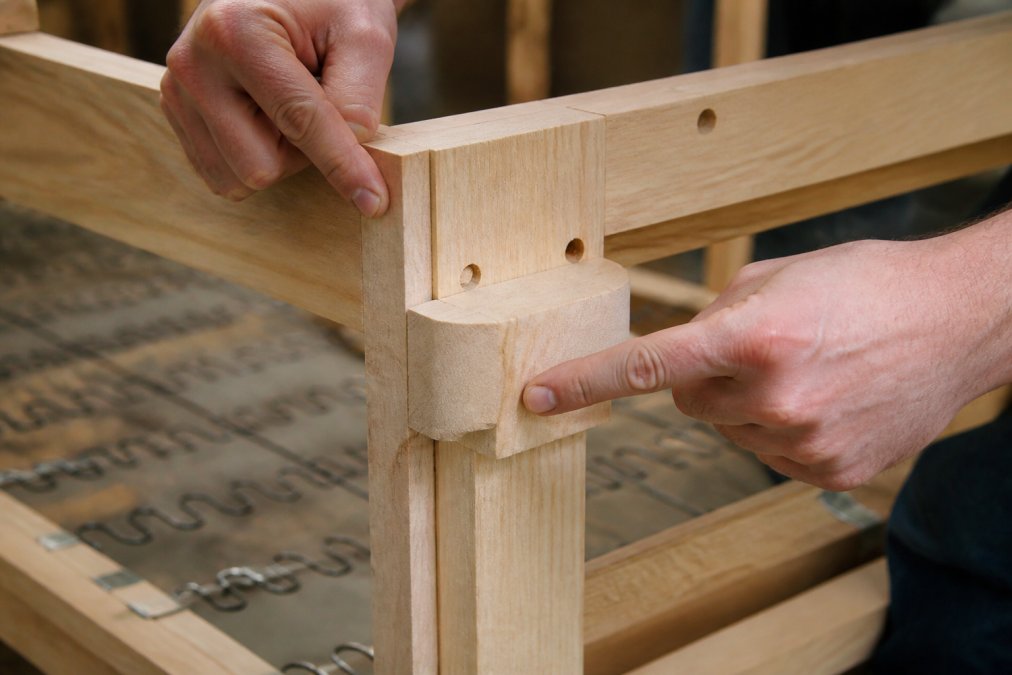
Corner blocks are triangular or L-shaped pieces glued and screwed to reinforce joints where frame members meet at right angles. They’re critical because corners bear the highest stress, when weight is distributed across the sofa, the corners experience both compression and racking forces.
Quality frames have substantial corner blocks made from solid hardwood, attached with glue and multiple screws, adding to load-bearing capacity.
Budget frames use small corner blocks attached with glue alone, providing minimal reinforcement. Some omit corner blocks entirely.
Inspect corner blocks carefully. Quality construction shows substantial, well-fitted blocks with visible screw holes and clean glue lines. Cheap construction shows thin blocks, gaps between the block and frame members, or blocks that appear to be an afterthought rather than integral to the design.
Identifying Signs of Quality Craftsmanship
Beyond joinery, quality craftsmanship is visible in several details:
Wood grain and finish. Solid wood frames should show clean wood grain and be kiln-dried (8-12% moisture content) to prevent warping. Quality construction feels smooth with tight joints; cheap construction shows rough surfaces and gaps.
Consistency across the frame. Quality manufacturers use the same wood species throughout; budget makers mix hardwood in visible areas with softwood or plywood in hidden areas. Ask if the entire frame is solid hardwood.
Webbing and suspension attachment. Quality construction attaches springs at multiple points along each rail, distributing load evenly. Budget construction uses minimal attachment points, concentrating stress and causing premature sagging.
Resistance to Warping, Sagging, and Long-Term Performance
Warping and sagging are the primary failure modes of poorly constructed sofas. Understanding how these occur and how quality frames resist them reveals why solid wood construction matters.
Kiln-Drying and Moisture Control
Moisture is the enemy of frame stability. Kiln-dried wood (8-12% moisture content) remains stable; uncontrolled moisture causes warping, twisting, and cracking.
Quality manufacturers use kiln-dried hardwood throughout, explaining why their frames remain stable.
Particle board and plywood are particularly vulnerable to moisture because the adhesives break down when exposed to humidity. A solid wood frame with proper joinery resists moisture-related degradation far more effectively.
Suspension Systems and Cushion Support
The frame alone doesn’t determine how a sofa feels or performs. The suspension system, the material that bridges the frame and supports the cushions, is equally critical. Quality sofas use eight-way hand-tied springs or high-quality sinuous (serpentine) springs mounted to the frame with proper tension.
Eight-way hand-tied springs are individually tied to the frame at eight points, creating a suspension system that distributes weight evenly and resists sagging.
The frame’s structural integrity directly affects suspension longevity. A weak frame transmits excessive stress to the springs, causing premature failure. A solid wood frame distributes load evenly, allowing the suspension system to perform as designed for the sofa’s entire lifespan.
Sustainability and Repairability: Why Frame Quality Matters Beyond Price
A sofa built to last decades has environmental advantages over one destined for landfill after five years. Solid wood frames from sustainable sources represent a more responsible choice than engineered alternatives that cannot be repaired or recycled. This is where the true cost-per-year calculation becomes compelling.
Sourcing and Certification: What Sustainable Solid Wood Means
Not all solid wood is equal from an environmental perspective. The sourcing of timber matters significantly. Responsibly sourced hardwoods come from managed forests where trees are replanted and harvesting is regulated to maintain forest health. The Forest Stewardship Council (FSC) certification is the most widely recognised standard for responsible timber sourcing. FSC-certified wood comes from forests that meet strict environmental, social, and economic standards, ensuring that harvesting doesn’t deplete resources or damage ecosystems.
When evaluating a sofa, ask whether the frame uses FSC-certified hardwood. This single specification indicates that the manufacturer prioritises sustainability and is willing to pay a premium for responsibly sourced timber. Many retailers won’t volunteer this information, but quality manufacturers are proud to highlight it.
Engineered alternatives, plywood and particle board, are often marketed as sustainable because they use wood waste and offcuts. However, the adhesives used to bind these materials typically contain formaldehyde or other volatile organic compounds (VOCs).
Repairability: Extending Sofa Life Through Maintenance and Restoration
Quality frames are repairable in ways that budget sofas are not. This is where solid wood construction delivers genuine environmental and economic value.
The True Cost of Ownership: Price Per Year
The true cost of a sofa isn’t the purchase price; it’s the cost per year of ownership. When you factor in the cost of disposal and the environmental impact of manufacturing a replacement, the solid wood option becomes a more economical choice in the long run.
Frequently Asked Questions
Which wood is best for a sofa frame?
Hardwoods like beech and oak are superior for sofa frames because they offer greater structural integrity, weight capacity, and resistance to warping compared to softwoods. Hardwoods have higher frame density, which prevents sagging and extends the frame lifespan significantly. Softwoods can work but require more careful construction and maintenance to achieve comparable durability. The choice depends on the frame’s overall construction quality, joint methods, and how the wood is kiln-dried to control moisture content.
What makes a solid wood sofa frame better than plywood?
Solid wood frames provide superior load-bearing capacity and structural integrity compared to plywood or particle board. Solid wood resists warping and racking far better, maintains tensile strength over decades, and can be repaired or refinished if damage occurs. Plywood, whilst cheaper, lacks the durability and longevity of solid wood and cannot be effectively repaired. For a sofa you intend to keep for the long term, solid wood frames justify the investment through reduced sagging and frame wobbling.
How can you tell if a sofa frame is high quality?
Examine the joints first: mortise-and-tenon joints indicate superior craftsmanship compared to dowel joints or glued-and-stapled construction. Feel the frame for stability and wobbling when you apply pressure. Check whether the wood is kiln-dried (look for uniform colour and lack of cracks). Quality frames use corner blocks for reinforcement and proper suspension systems. Ask the maker about wood species, moisture content, and construction methods. Reputable makers like Tetrad offer guidance on their frame construction and materials.
Does a solid wood frame prevent sofa sagging?
A solid wood frame is essential for preventing sagging, but frame quality alone doesn’t guarantee it. The frame must be constructed with proper joints (mortise-and-tenon preferred), kiln-dried to stable moisture content, reinforced with corner blocks, and paired with a quality suspension system. Softwood frames or poorly constructed solid wood frames can still sag under weight. The combination of solid hardwood, expert construction, and appropriate suspension creates a sofa that resists sagging and maintains cushion support throughout its lifespan.
