
Blog
How to Identify Quality Handcrafted Furniture
Nov
Quick Summary
To identify quality handcrafted furniture, check what it is made from, examine the joinery under the surface, test frame strength and balance, and inspect drawers, hardware and finish. Solid wood, tight mortise and tenon or dovetail joints, a rigid frame that sits level, and smooth, even finishing all point to good construction.
- Confirm whether the frame and visible surfaces are solid wood or veneer, and ask the seller directly.
- Look for tight mortise and tenon or dovetail joints, with no gaps or filler hiding poor fits.
- Lift one corner of a chair or sofa; a good frame stays rigid with no twisting.
- Pull drawers out and push them back; they should run smoothly and stop gently without slamming.
- Ask for the joints, timber drying method, finish and repair options in writing before you buy.
Table of Contents
- Why Handcrafted Furniture Is Worth Checking Carefully
- Step 1: Work Out What the Piece Is Made From
- Step 2: Examine the Joinery Under the Surface
- Step 3: Test Frame Strength, Balance and Weight
- Step 4: Check Drawers, Hardware and Surface Finish
- Telling Handcrafted from Mass-Produced Furniture
- Booking a Consultation Before You Buy Your Next Piece
- Frequently Asked Questions
Why Handcrafted Furniture Is Worth Checking Carefully
Handcrafted furniture can look almost identical to mass-produced pieces in a showroom.
At Tetrad sofas. Tetrad chairs., we want you to be able to judge quality for yourself. This guide walks through the checks that matter most, whether you are in a showroom or reading a product page.
Many buyers assume that a higher price always means better construction. That is not always true. Price tells you something, but it does not tell you how a piece was built.
- Materials decide how a piece ages, and a guide to what to look for in sofa frames covers kiln-dried hardwood and mortise and tenon joints.
- Joinery decides how it holds together
- Finish decides how well it resists daily wear
Step 1: Work Out What the Piece Is Made From
Start by asking what the piece is actually made of. Sellers sometimes use words like “wood” or “timber” in ways that hide the real material underneath.
Solid wood, veneer, engineered wood and particleboard
Solid wood is cut from a single piece of timber throughout. Discover why solid wood sofa frames outlast engineered alternatives and how to identify them.
Veneer can look beautiful, but it is more fragile. A deep scratch or water ring can expose the core underneath, and a veneered surface cannot be sanded back the way solid wood can.
Ask the seller directly: is the frame solid wood, and is the visible surface solid or veneered?
Reading grain, colour and texture
Solid wood has a grain that runs continuously through the piece. Look at the end of a leg or the edge of a table top.
Veneer and printed finishes often repeat the same pattern. If two panels look exactly alike, that can be a sign of printed or sliced veneer rather than individually selected timber.
Texture helps too. Solid wood feels slightly warm and varied under the hand. Laminate and printed surfaces often feel flat and uniform.
Step 2: Examine the Joinery Under the Surface
Joinery is how the pieces of a frame are connected. Good joinery holds a piece together for decades. Weak joinery loosens, creaks, and eventually fails. This is the section where a few minutes of inspection tells you more than any showroom finish.
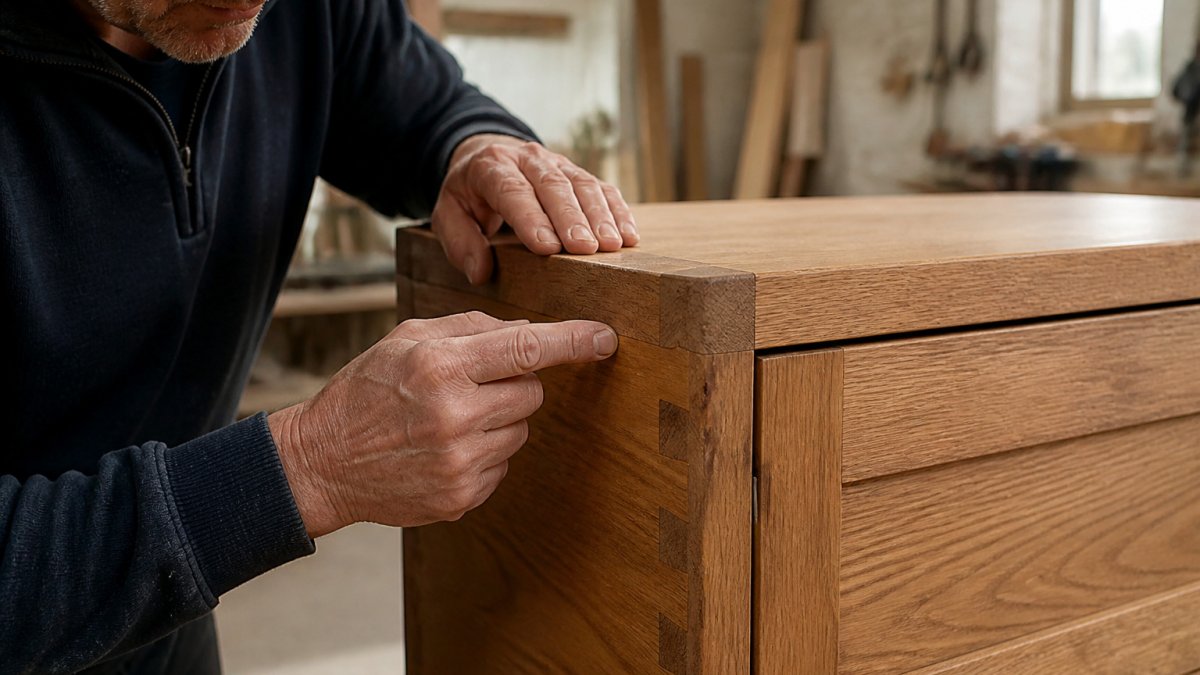
Look at the corners and joints you can see, and check the underside and back where the construction is often more exposed.
The joints that matter
- Mortise and tenon joints: A tongue cut into one piece fits into a slot in another, usually glued and sometimes pinned with a dowel. These are strong and common in good frames. Look for a tight shoulder line where the two parts meet, with no visible gap or squeeze-out of filler.
- Dovetail joints: Interlocking fingers that resist pulling apart. You will often see these in drawers and cabinets. Hand-cut dovetails are slightly irregular in spacing and angle; machine-cut dovetails are perfectly uniform. Neither is automatically better, but the pins should be tight, with no cracks running from the corners.
- Finger joints and comb joints: Interlocking rectangular fingers, often used to join boards end to end in cheaper frames and drawer boxes. They are strong enough in the right place but are a sign of a built-up component rather than a single piece of timber.
What to look for at the joint itself
A well-cut joint closes tightly. Run a fingernail across the seam: if it catches, there is a gap. Look for filler or wax crammed into a joint to hide a poor fit, and for cracks radiating from screw holes or staple lines.
A common mistake is judging joinery only by how the piece looks on the day you buy it. Gently rock the frame or pull on a drawer. Any movement, creaking, or gaps suggest the joints may loosen with use.
If the frame is upholstered and you cannot see the joints, ask the maker which joints are used at the corners and rails, and whether the frame is glued, pinned or both. A specific answer, for example, mortise and tenon at the rails with glued and pinned corner blocks, is a better sign than a general claim of solid construction.
Joinery and repairability
Good joinery is also repairable joinery. A glued mortise and tenon can often be re-glued and clamped; a joint held only by staples or screws may have crushed the timber around the fixing, leaving little to repair. If you plan to keep a piece for years, ask the retailer whether a repair service and spare parts are available.
The joint types below are the ones the article describes, along with what each one means for a piece’s strength.
| Joint | What it looks like | Why it matters |
|---|---|---|
| Mortise and tenon | Tongue fits into a slot, often glued and pinned | Strong and common in good frames |
| Dovetail | Interlocking fingers, often in drawers | Resists pulling apart |
| Finger or comb joint | Interlocking rectangular fingers | Built-up part, not single timber |
| Dowelled joint | Wooden or metal dowels, usually glued | Common in mid-market and flat-pack |
| Screws or corner blocks only | Fixings and brackets | Less strong over time |
Step 3: Test Frame Strength, Balance and Weight
A well-made frame feels solid when you handle it, and it sits level on the floor.
Try these simple checks:
- Lift one corner of a chair or sofa slightly. A good frame stays rigid, with no twisting.
- Place the piece on an uneven surface, or check it on a level floor. It should not wobble or rock.
- Compare the weight with similar pieces. Solid timber is heavier than engineered alternatives of the same size, so a surprisingly light frame may use less substantial materials.
Weight alone does not prove quality, but it gives you a useful clue when you compare two options side by side.
Step 4: Check Drawers, Hardware and Surface Finish
Drawers and hardware are often where cheaper furniture shows its limits first.
Pull each drawer out and push it back in. A checklist for examining frames, suspension, cushions and stitching helps you judge the rest of the piece before you buy.
Check the handles and fittings. Screws should be tight, and handles should feel firm.
Finally, look closely at the surface. Run your hand across the top and the edges.
For upholstered pieces, check the stitching. Seams should be straight, tight, and evenly spaced. Loose or puckered stitching often signals rushed work.
Telling Handcrafted from Mass-Produced Furniture
Handcrafted and mass-produced furniture can look similar at a glance. The differences lie in detail, and in what the maker can show you. This section gives you a way to verify a handmade claim rather than take it on trust, an angle most buying guides skip.
Evidence that means something
- Tool marks in hidden places. Hand work often leaves plane tracks, chisel marks or slight facet lines on the underside of a seat rail, the inside of a drawer box or the back of a leg. These are meaningful when they are consistent and in places a machine would not reach. They are not meaningful when they are sanded into a visible top as a decorative effect.
- Construction variation. Hand-cut joints vary slightly in spacing and angle from one corner to the next. Machine-cut parts are identical. Variation is only evidence of hand work when it is paired with tight fits; sloppy gaps are not craftsmanship.
- Individually selected timber. Grain that runs continuously across a drawer front and its sides, or boards that are book-matched across a table top, suggests the maker planned the piece rather than assembled random parts. Repeated identical grain patterns across panels point the other way.
Evidence that means little
Distressed edges, visible knots, exposed screws and a rustic finish are styling choices, not proof of hand work. A high price is not proof either. Mass-produced pieces can be finished to look handmade, and small workshops can use machine-cut parts for good reason. Judge the construction, not the story.
A short verification sequence
- Ask for the species and the construction method in writing, including whether visible surfaces are solid or veneered.
- Ask which joints are used at the frame corners and rails, and whether they are glued, pinned or both.
- Ask how the timber is dried and whether it is acclimatised before assembly.
- Ask what finish is used and how a scratch or water mark is repaired.
- Ask the retailer about the warranty and any spare parts or repair support it offers.
- Compare the answers with what you can see and feel on the piece.
Handmade is a claim about process, not appearance. See why handcrafted furniture outlasts factory-made pieces through materials, joinery and repairability. The strongest evidence is a maker who can describe specific methods, show consistent detail in hidden places, and stand behind the piece with documented aftercare and repair support.
Online and distance buying
When you cannot handle the piece, ask for photographs of the underside, the back, the drawer box and any maker’s mark. Request a short video of a drawer running and a frame being rocked. Read the retailer’s warranty and returns policy before ordering, and confirm who pays return carriage on a large item. These checks do not replace handling the furniture, but they close much of the gap.
Booking a Consultation Before You Buy Your Next Piece
Checking furniture yourself is useful, but a conversation with a specialist can answer questions you cannot settle in a showroom.
At Tetrad sofas. Tetrad chairs., we offer expert, personal guidance to help you navigate every fabric, leather, and collection, ensuring you find the perfect piece for your home.
Ready to find the right piece for your home? explore our collection and see the range for yourself.
Frequently Asked Questions
How do you know if furniture is real wood?
Look at the edges, the underside and any exposed end grain. Solid wood shows grain that continues around corners and varies from board to board, while veneer shows a repeated pattern and a thin layer over a different core. Check the edge of a tabletop or the inside of a drawer front: particleboard or MDF looks uniform and granular, often with a visible plastic-like sheen. Weight is also a clue, since solid hardwood feels noticeably denser than engineered boards. If a retailer cannot tell you the species and construction in writing, ask for that detail before you buy.
What should you look for in furniture joinery?
Strong handcrafted furniture uses joints that are cut to fit, not held together mainly by staples, glue blocks or visible screws. Dovetails on drawers, mortise and tenon joints in frames and well-fitted corner joints are all good signs. Gaps should be tight and even, and the glue should be neatly removed rather than smeared. Pull gently on each joint and listen for creaks or movement. Good joinery is most visible on the underside, the back and inside the drawers, so inspect those areas rather than only the front.
How can you tell handmade furniture from mass-produced furniture?
Handmade pieces usually show small variations: slightly different grain matches, hand-finished edges, and joints that are not perfectly identical across the piece. Mass-produced items tend to be uniform, with stapled upholstery, machine-pressed panels and identical repeated details. Ask the maker how long a piece takes to build, who builds it and whether they can show workshop photographs. Look for a maker’s mark or signature, but remember that a mark alone does not prove the work was done by hand.
What questions should you ask before buying handcrafted furniture?
Ask what species of wood is used and whether the frame is solid or veneered, how the joints are made, and what the finish is and how it can be repaired. Find out what the warranty covers, who stands behind it and how long it lasts. Check the expected lead time, delivery arrangements and whether the piece can be sat on or inspected before you commit. For upholstered pieces, ask about the frame construction, spring system and cushion fill. A reputable retailer will answer these questions clearly and in writing.

