
Blog
What to Look for in Sofa Frames: A 2026 Guide
Sep
Table of Contents
- Why the Frame Is the Sofa’s Skeleton
- Solid Wood vs Plywood Sofa Frames: Which Lasts?
- Best Sofa Frame Construction Methods and Joinery
- How to Test Sofa Frame Stability Before You Buy
- How Springs and Seat Support Connect to the Frame
- Signs of a Poor-Quality Sofa Frame
- What to Look for in Sofa Frames When Buying Online
- Frequently Asked Questions
Last Updated: September 15, 2026
Why the Frame Is the Sofa’s Skeleton
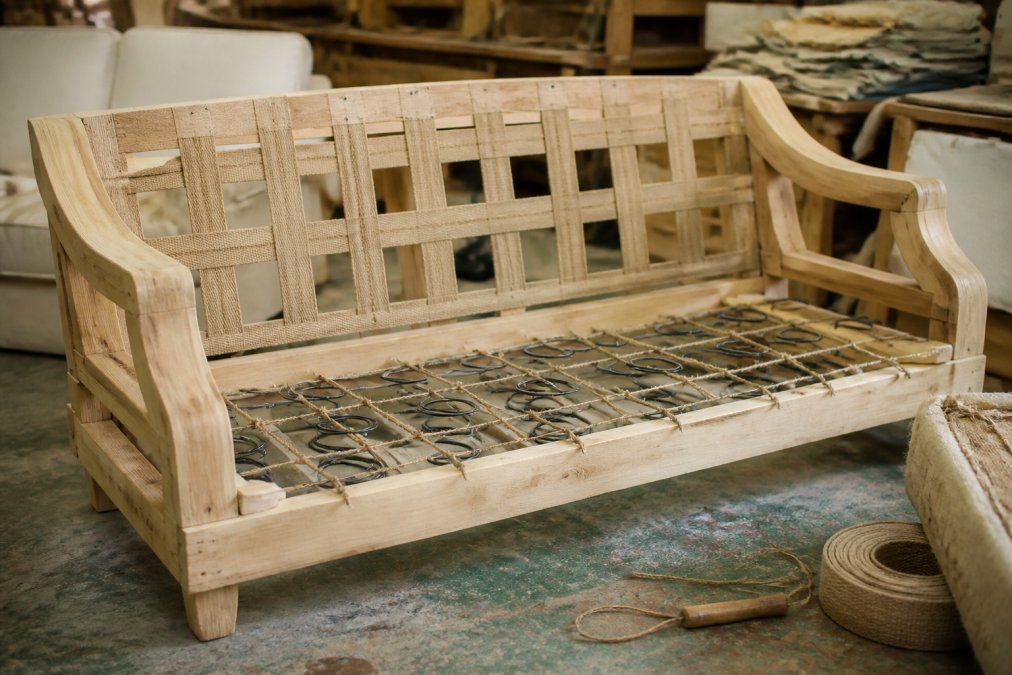
A sofa frame is the internal load-bearing structure that supports the seat, back, and arms, and it determines whether the piece lasts five years or twenty-five. When you’re weighing up what to look for in sofa frames, think of the frame as the skeleton: springs, webbing, foam, and fabric all hang off it, so if the frame flexes or twists, everything above it fails early. This guide from Artisan Sofas walks through the materials, joinery, and tests that separate a hand-built frame from a disposable one.
The frame is also the one component you cannot replace later. Cushions can be refilled, covers reupholstered, and legs swapped. A warped or cracked frame usually means the end of the sofa.
Judge a sofa by its frame first, because it is the only part you can never economically repair or replace once it fails.
Solid Wood vs Plywood Sofa Frames: Which Lasts?
Kiln-dried hardwood frames generally outlast plywood frames, but high-grade multi-ply is a legitimate second choice when it is thick, densely layered, and properly reinforced. The material matters less than how it is dried, cut, and joined.
Kiln-Dried Hardwood and High-Grade Multi-Ply
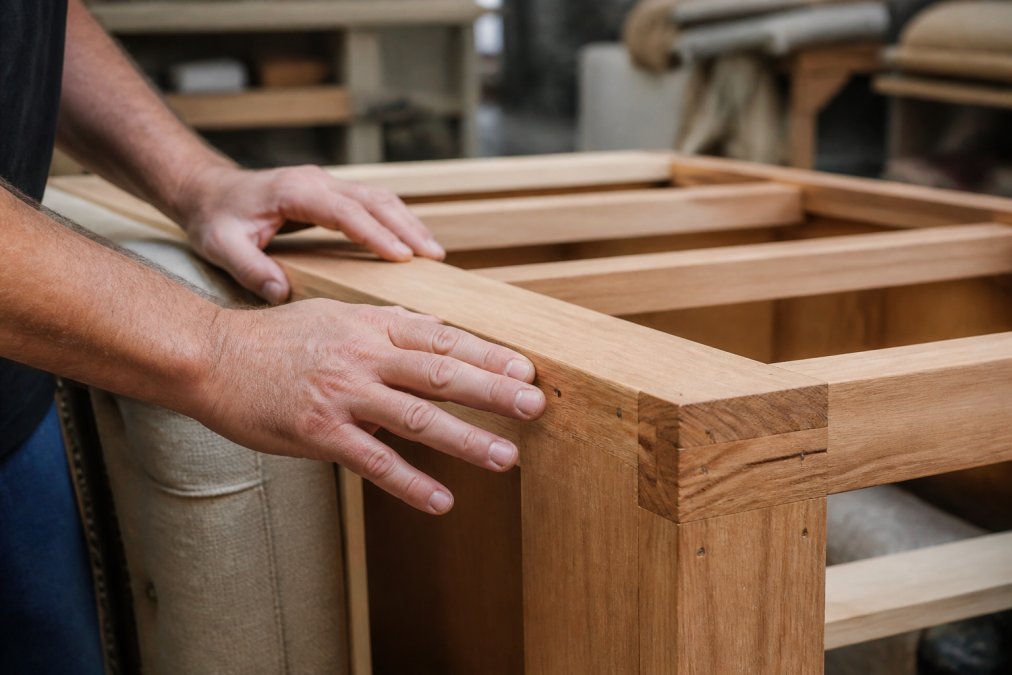
Kiln-dried hardwood is timber dried in a controlled kiln to a low moisture content before assembly. That drying step is what prevents the warping and cracking that plague green or under-dried timber once it sits in a heated room. Common species include beech, ash, and oak.
High-grade multi-ply is a laminated panel made from several cross-grained layers of wood bonded together. The alternating grain directions give it dimensional stability, so it resists the twisting that solid timber can suffer in fluctuating humidity. A thick, well-made multi-ply frame can perform well for years.
Where Particle Board and Chipboard Fall Short
Particle board and chipboard are made from wood chips and resin pressed into sheets. They are cheap, and they behave like it. Screws and staples tear out under repeated load, and the material crumbles rather than flexes. A frame built from chipboard may feel fine in a showroom and turn creaky within a couple of years of daily use.
| Frame material | Durability | Repairability | Typical use |
|---|---|---|---|
| Kiln-dried hardwood | Very high | High, joints can be re-glued | Premium hand-built sofas |
| High-grade multi-ply | High | Moderate | Mid to upper-range sofas |
| Particle board / chipboard | Low | Poor, fasteners tear out | Budget, short-life furniture |
Best Sofa Frame Construction Methods and Joinery
The strongest sofa frames use interlocking joinery reinforced with glue and corner blocks, not staples alone. A frame is only as good as the joints holding it together, which is why construction method matters as much as the wood species. Two frames can use identical kiln-dried beech and still differ by a decade of service life purely on how the rails meet the legs.
Mortise and Tenon, Dowel Joints and Corner Blocking
Mortise and tenon is a joint where a projecting tenon on one piece slots into a cut mortise on another, creating a large glued surface area. The mechanical interlock resists both pulling apart and twisting, and because the glue line is long, the joint tolerates the seasonal movement of timber far better than a butt joint. It is one of the most durable joints in furniture making and is the benchmark against which other methods are judged.
Dowel joints use wooden pins to align and lock two components. Done well, with glue and tight tolerances, they hold firmly; done cheaply, with undersized or short dowels and no glue, they loosen as the timber shrinks and the pins work in their holes. The tell is the number and diameter of dowels: two or three substantial dowels per joint behave very differently from a single small pin.
Corner blocking adds solid blocks of wood at the internal corners of the frame, usually glued and screwed in place. These blocks stop the frame from racking, the side-to-side twisting that destroys rigidity over time. Blocks are cheap to add and cheap to omit, which is why their presence is one of the clearest signals of whether a maker is building to last or building to a price.
Staples and screws alone are the weakest option. Staples hold in shear but pull out under the repeated racking load a sofa sees every time someone sits down at one end. A frame held together by staples alone will loosen far sooner than one with glued, blocked joints, and the creaking usually starts within the first year or two of daily use.
How to Tell Which Method Was Used
You rarely get to see the joints on a finished sofa, so judge by proxy:
- Ask directly whether the frame is mortise-and-tenon, dowelled, or stapled, and whether it is glued as well as fixed
- Ask whether the frame is corner-blocked, and request a photograph of an internal corner if buying remotely
- A frame that is glued and blocked will feel silent and rigid when you lift a corner; a stapled frame will often creak or knock
- Heavier frames are not automatically better, but a frame that feels suspiciously light for its size is usually thin-sectioned and stapled
Ask any retailer whether the frame is corner-blocked and glued as well as stapled. A frame held together by staples alone will loosen far sooner than one with glued, blocked joints.
Why Joinery Also Decides Repairability
Joinery choice is not only about how long a frame lasts, but whether it can be brought back when it does loosen. Glued mortise-and-tenon and dowelled joints can often be re-glued and re-clamped by a furniture restorer, extending the sofa’s life by years. A frame that relies on staples into particle board or thin ply cannot be re-glued in any meaningful way, because there is no sound material left for the fastener to grip. That is the practical dividing line between a frame worth repairing and one that is effectively disposable once it starts to move.
How to Test Sofa Frame Stability Before You Buy
To test sofa frame stability, lift one front corner of the sofa a few centimetres and watch the opposite corner. On a rigid frame, the whole sofa moves as one unit; if the opposite leg stays planted or the frame twists, the joints are loose and the frame will not hold up.
How Springs and Seat Support Connect to the Frame
Signs of a Poor-Quality Sofa Frame
What to Look for in Sofa Frames When Buying Online
Read the Specification Like a Spec Sheet
Ask These Questions Before You Commit
Judge the Photographs, Not the Staging
Weigh the Frame Against the Whole-Life Cost
Buying on price alone is the most common mistake. A cheaper frame built from chipboard and staples can cost more over ten years than a well-built hardwood frame, because it will need replacing long before the good one wears out.
Frequently Asked Questions
What is the best frame for a sofa?
Kiln-dried hardwood is the benchmark. It resists warping and holds joints tight for decades. High-grade multi-ply is a solid second, offering stability at a lower weight. Metal frames suit compact designs but can flex over time. Skip particle board and chipboard entirely; they crumble at stress points and rarely survive a decade of daily use.
How can you tell if a sofa frame is well-constructed?
Lift one front corner about 15cm off the floor. A well-built frame keeps the opposite corner planted. A weak one twists or creaks. Then press down on the seat and armrests; listen for squeaks and feel for flex. Ask about the joinery: mortise and tenon, dowel joints and corner blocking all signal a frame built to last.
Is a solid wood frame better than a metal frame for a sofa?
For most homes, yes. Solid hardwood handles load-bearing stress without flexing, and it can be repaired or refinished. Metal frames are lighter and suit smaller pieces, but welded joints can crack and are difficult to fix. Solid wood also accepts staples and screws better for upholstery, so the covering stays tight for longer.
What are the signs of a poor-quality sofa frame?
Watch for these red flags: a frame made from particle board or chipboard, visible staples rather than proper joinery, a sofa that wobbles when you lift one corner, creaking sounds under light pressure, and no information about the wood type. If a retailer cannot tell you how the frame is built, that silence usually answers the question.
How does frame construction affect the longevity of a sofa?
The frame is the skeleton everything else attaches to. Springs, webbing, foam and fabric all rely on it staying rigid. A kiln-dried hardwood frame with mortise and tenon joints and corner blocking can hold its shape for 20 years or more. A chipboard frame may sag within five, dragging the cushions and upholstery down with it.
How do I check the frame when buying a sofa online?
Ask the retailer three questions: what wood is used, how the joints are constructed, and whether the frame carries its own guarantee. Request close-up photographs of the frame before upholstery is applied. Check the product page for terms like kiln-dried hardwood, mortise and tenon, and corner blocking. If none appear, treat it as a warning sign.
A sofa is a long-term purchase, and the frame decides whether it lasts a decade or a generation. If you want the reassurance of a hand-built frame you can question us about in detail, Artisan Sofas offers expert, personal guidance across every fabric, leather, and collection, with handcrafted Tetrad pieces and professional white glove delivery to your door. Explore the collection and find a sofa built to last.
