
Blog
Luxury British Furniture Design Trends 2026
Sep
Table of Contents
- Why 2026 Is the Year of Lived-In Luxury
- The Evolution of Traditional Chesterfield Sofas in 2026
- Handcrafted British Furniture Benefits: Quality That Lasts Decades
- Sustainable Luxury Furniture UK: Circular Sourcing and Investment Longevity
- Smart Home Integration in Luxury Furniture
- Small-Space Luxury Living: Space Planning and Functional Art
- What to Ignore: Common Bad Advice in Luxury Furniture Buying
- Conclusion
- Frequently Asked Questions
Last Updated: September 14, 2026
Why 2026 Is the Year of Lived-In Luxury
The most significant shift in luxury british furniture design trends 2026 is the move away from showroom perfection toward spaces that feel genuinely inhabited, with luxury british furniture now chosen for daily life rather than display. Warm minimalism has replaced stark, gallery-like interiors, and the result is furniture that invites you to sink in rather than stand back and admire. This guide from Artisan Sofas examines the trends shaping British interiors this year, from curved silhouettes to sustainable sourcing, and explains why investment pieces now matter more than ever.
The past decade’s white walls, glass surfaces and photogenic-but-impractical furniture are fading. Buyers now want material depth, layered textures and pieces that improve with age.
Warm Minimalism and Earthy Palettes
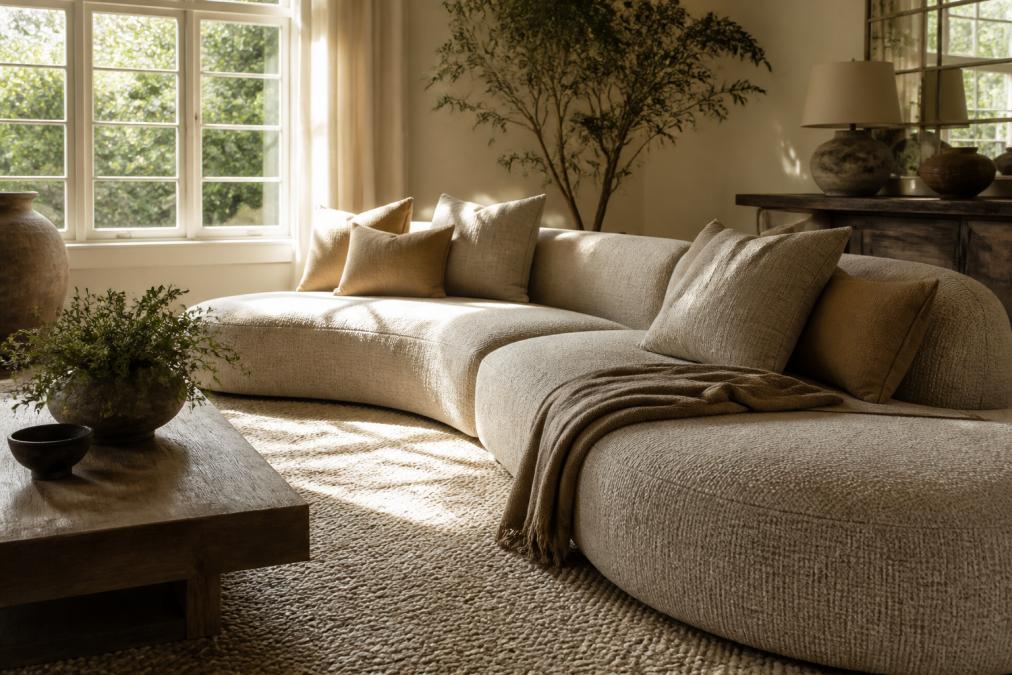
Warm minimalism reduces clutter and visual noise while keeping the palette, textures and lighting soft and inviting. It retains earlier minimalism’s restraint but adds earthy tones, botanical greens and tactile surfaces.
A warm minimal room still needs fewer pieces, but each carries more visual weight: one oversized bouclé armchair does more work than three generic chairs. Heritage blue has emerged as a grounding neutral alongside clay, ochre and stone.
Curved Silhouettes and Organic Geometry
Organic geometry is reshaping furniture across every price bracket. Curved details, rounded arms and sculptural silhouettes have replaced the sharp, boxy lines of the previous decade, softening rooms and making open-plan spaces feel less institutional.
Retro-soaked sofas with gentle arcs and plush tufted ottomans express this most clearly. Curves also solve a practical problem: in smaller rooms, a rounded piece allows better circulation than a rectangular one of the same footprint.
The Evolution of Traditional Chesterfield Sofas in 2026
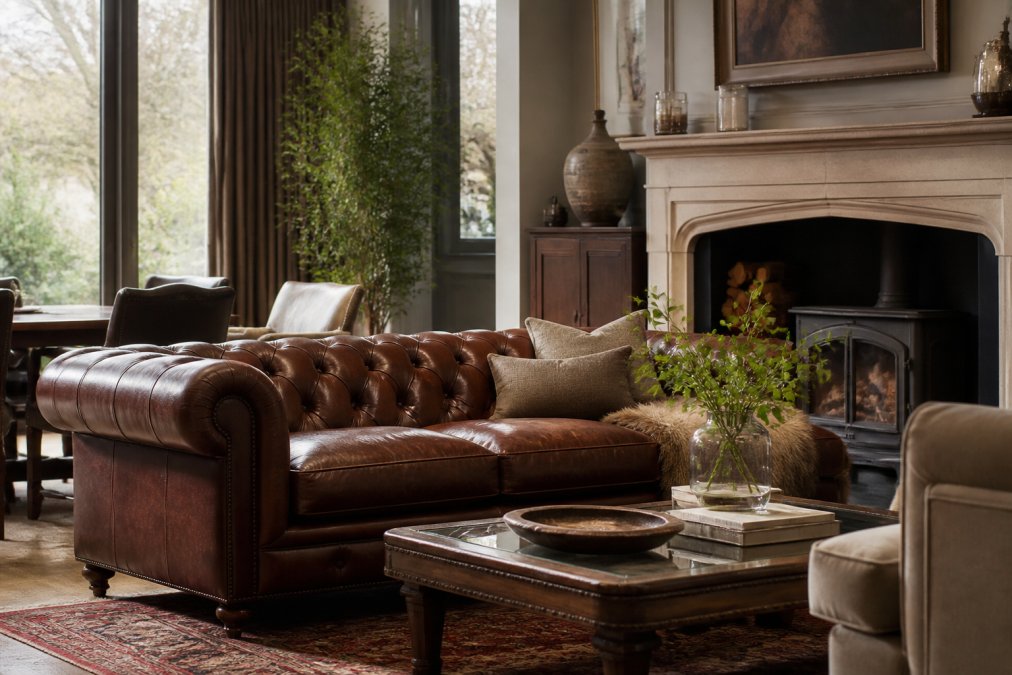
Traditional chesterfield sofas are being reinterpreted rather than abandoned. The deep-buttoned back and rolled arms remain, but makers are softening proportions, reducing button density and using lighter, more tactile upholstery. A lower back, shallower seat and relaxed roll make the form usable where people actually recline.
This is the trend most buyers get wrong. A dark leather chesterfield scaled to a formal drawing room looks dated in a contemporary open-plan home; the same frame in mid-weight linen with a lower back and shallower buttons reads as current. The difference is scale, fill and finish, not silhouette.
| Chesterfield Style | Upholstery | Best For | 2026 Relevance |
|---|---|---|---|
| Classic deep-buttoned | Dark leather | Formal reception rooms | Heritage appeal, narrower market |
| Softened buttoning | Linen or cotton blend | Open-plan living | Strong demand |
| Button-free curved arm | Bouclé or velvet | Small-space luxury | Fastest-growing variant |
| Two-seat compact | Textured weave | Flats and apartments | Practical investment |
What Actually Changes the Feel
Three construction choices separate a current chesterfield from a period piece:
- Back height and pitch. Dropping the back a few centimetres and easing the rake turns a formal perch into a seat you can sink into, the biggest visual and comfort change.
- Button density. Full deep buttoning is labour-intensive and visually heavy. Fewer buttons, or none on the arms, lightens the piece without losing the rolled profile.
- Fill and suspension. Traditional chesterfields used horsehair and coil springs; contemporary makers combine a hardwood frame with serpentine or pocket springs and high-resilience foam or feather-wrapped cushions. Feather wraps feel plusher but need plumping; foam holds its shape with less maintenance.
The Frame Is the Investment
Frame quality separates a piece that lasts from one that sags. Handcrafted British furniture benefits show most clearly here: a hardwood frame, traditionally jointed and corner-blocked, holds its shape for decades, while stapled softwood will not. On a chesterfield, the rolled arm is the stress point, taking the weight of everyone who leans on it; a properly jointed and glued arm outlasts a stapled one by a wide margin.
This is where the investment-piece argument becomes concrete. A chesterfield with a sound hardwood frame and removable cushions can be reupholstered, re-filled, re-tied and re-webbed repeatedly. A cheaper one with a stapled frame and fixed cushions cannot be economically repaired, when the foam collapses, the whole piece goes.
On a chesterfield, ask three questions: what is the frame made from, are the cushions removable, and can the buttons be re-tied? If the answer to any is no, the piece is a short-term purchase dressed as a heritage one.
Choosing the Right Variant for Your Room
A two-seat compact chesterfield suits a flat or narrow reception room where a three-seater would block circulation. A button-free curved-arm version works in open-plan space, its cleaner line reading as contemporary rather than costume. A classic deep-buttoned piece still earns its place in a formal room with the height and floor area to carry it.
The mistake is buying the chesterfield you remember from a hotel lobby rather than the one that fits your room. Measure the wall, note the door width and check seat depth against how you sit: 5 cm too deep is the difference between daily use and avoidance.
Handcrafted British Furniture Benefits: Quality That Lasts Decades
The core benefit of handcrafted British furniture is longevity built into the structure, not applied as a finish. A properly jointed and sprung frame can be reupholstered several times, adapting to changing tastes instead of being replaced.
The frame decides the lifespan. Upholstery is renewable; a failing frame is not. Ask what the frame is made from and how the joints are secured before you consider fabric.
Longevity is an economic argument, not just a sentimental one: a piece that can be reupholstered avoids the cost and waste of replacement and holds resale value far better than flat-pack equivalents.
Setup and delivery matter more than buyers expect. A heavy, well-built sofa needs careful positioning to avoid marking floors and straining doorframes, which is where a professional white glove service earns its place: two-person delivery with placement removes damage risk during the most awkward part of the process.
Sustainable Luxury Furniture UK: Circular Sourcing and Investment Longevity
Sustainable luxury furniture UK buyers increasingly judge on circularity: where the timber comes from, how the piece is built, and whether it can be repaired rather than discarded. Trend-led coverage skips this angle, yet it has the longest-term consequences.
Circular sourcing means responsibly grown hardwood, avoiding glues and foams that cannot be separated at end of life, and designing so components can be replaced individually. The buyer’s test is simple: can this piece be reupholstered, and can a leg or cushion be replaced without scrapping the whole item?
Investment piece longevity follows directly. A sofa built to be maintained holds value and stays in use; a cheaper piece that cannot be repaired becomes waste within a few years. The UK government guidance on waste and resource efficiency sets out the wider policy direction toward keeping products in use for longer, and furniture sits squarely within it.
Smart Home Integration in Luxury Furniture
Smart home integration is quietly becoming a specification point in higher-end furniture. Charging surfaces, discreet cable routing, integrated ambient lighting and motorised recliner mechanisms are now requested alongside fabric choices.
The design challenge is hiding the technology, since visible ports and trailing cables undermine warm minimalism. Better solutions build charging points into side tables, route cables through the frame and use ambient lighting that dims to suit the room rather than announcing itself.
Avoid buying furniture with non-standard or proprietary electronics. If a control unit fails after a few years and cannot be replaced, the smart feature becomes dead weight in an otherwise sound piece.
Small-Space Luxury Living: Space Planning and Functional Art
Small-space luxury living depends on space planning rather than square footage. A single correctly scaled statement piece delivers more impact than several smaller items competing for attention, an angle most trend-led guides skip, assuming large homes while a growing share of luxury buyers furnish flats, mews houses and converted upper floors where every centimetre is contested.
Measure Before You Choose
Start with a floor plan using real numbers: wall length, door width and swing, turning circle, and the distance between the sofa front and the nearest opposing surface. A common pattern is a usable wall shorter than the sofa the buyer has in mind, it fits on paper but leaves no circulation space once delivered.
As a working rule, allow at least 45 cm of walking space between the front edge of a sofa and a coffee table, and 75-90 cm for a main traffic route through the room (the NHS). Below those figures, the room feels tight regardless of how good the furniture is.
Functional Art: One Piece, Several Jobs
Functional art is the principle at work: a sculptural floor lamp that also lights a reading corner, a curved ottoman doubling as seating and storage, a sofa sized to the room rather than the showroom. In a small space, every piece should earn its footprint by doing at least two things.
Useful examples that hold up in practice:
- Storage ottomans with a lift-off lid or a hinged top, used for throws, magazines or occasional bedding.
- Nesting side tables that tuck under one another when not in use, then separate when guests arrive.
- Sofa beds with a proper mattress rather than a thin foam fold-out, the difference in comfort is substantial, and a poor mechanism will fail long before the frame does.
- Wall-mounted or slim-profile shelving that uses vertical space instead of floor area.
- A single oversized armchair in a textured bouclé, which anchors a corner more effectively than two small chairs.
Scale, Proportion and Light
Scale is where small-space luxury is won or lost: too large a sofa shrinks the room, too small makes it feel provisional. Aim for a piece that fills its wall confidently without crowding the route past it.
Light matters as much as furniture. A large mirror opposite a window doubles apparent depth, and a pale, warm-neutral palette reflects more light than a dark one (sciencedirect.com). Layered lighting, floor lamp, table lamp and dimmable ceiling source, changes the mood without changing the furniture.
Layered Textures Without Clutter
Layered textures do the rest: a nubby rug, tactile upholstery and a couple of plush cushions add richness without adding furniture, so the room feels curated rather than crowded. Keep the palette to two or three related tones and let texture carry the variation instead of pattern.
In a small room, choose the rug before the sofa. A rug that is too small makes the seating area feel like an island; one that extends under the front feet of the sofa ties the scheme together and makes the room read as larger.
What to Avoid
The most common small-space error is buying a matching suite: three coordinated pieces fill a room and leave no breathing space. The second is choosing visible legs and open bases in a very small room, solid or skirted bases read as more generous because they create a continuous line. The third is treating storage as an afterthought; in a flat it is a design decision, not a furniture add-on.
What to Ignore: Common Bad Advice in Luxury Furniture Buying
The most persistent bad advice is to buy the largest piece that fits. Oversized furniture shrinks a modest room and forces awkward circulation, the opposite of luxury.
Second, ignore the idea that matching sets create cohesion. Coordinated suites date quickly and lock you into one look; a curated mix of complementary pieces ages far better.
Third, treat “investment” as a claim to verify, not a label to trust. Ask about frame construction, joint type and reupholstery; a common mistake is paying a premium for a name while accepting a stapled frame underneath.
Ask to see a frame sample or a cutaway. A retailer confident in construction will show you what is under the upholstery. If they cannot, that tells you something.
Conclusion
Choosing furniture that still looks considered in ten years demands judgement about construction, materials and proportion, not colour alone. Artisan Sofas specialises in handcrafted British furniture from Tetrad, offering personal guidance through every fabric, leather and collection choice, backed by over 50 years of craftsmanship and a professional white glove delivery service.
Frequently Asked Questions
What are the most popular furniture styles in 2026?
In 2026, lived-in luxury leads with warm minimalism, earthy tones, and sculptural, curved silhouettes. Heritage blue acts as a grounding neutral, while tactile upholstery and plush tufted ottomans add comfort. Traditional Chesterfield sofas are reimagined with organic geometry, and sustainable luxury furniture UK focuses on bespoke craftsmanship and circular sourcing. Smart home integration and small-space luxury living are also gaining traction, blending technology with timeless aesthetics.
Why is handcrafted British furniture considered a sustainable investment?
Handcrafted British furniture benefits include using solid hardwoods from responsibly managed forests, traditional joinery that avoids glue-heavy construction, and a lifespan of decades rather than years. This reduces waste and the need for frequent replacements. Many makers now offer repair and reupholstery services, supporting circular sourcing. As a result, each piece locks up carbon for longer and retains value, making it a sustainable luxury furniture UK choice that aligns with investment piece longevity.
How to style a traditional Chesterfield sofa in a modern home?
To modernise a traditional Chesterfield sofa, choose a neutral or heritage blue leather to bridge classic and contemporary. Pair it with a low-profile coffee table and a nubby rug to add texture. Use ambient lighting and botanical greens to soften the buttoned silhouette. For small spaces, opt for a two-seater and avoid heavy drapes. Layering with a throw and contrasting cushions keeps the look curated yet comfortable, honouring the sofa’s craftsmanship while fitting a 2026 aesthetic.
The trends above will keep moving, but the fundamentals of a well-built piece will not. Explore the Artisan Sofas collection to find handcrafted British furniture matched to your space, your palette and your long-term plans.
