
Blog
Durable Fabrics for High-Traffic Sofas
Sep
Table of Contents
- What Makes a Fabric Durable for High-Traffic Sofas
- Understanding the Martindale Rub Test Explained
- Synthetic Fibres vs Natural Fabrics for Durability
- Best Upholstery Fabrics for Pets and Busy Households
- How to Clean High-Traffic Sofa Fabric Effectively
- Real-World Performance: Lab Tests vs Everyday Wear
- Selecting Your Sofa Fabric: A Practical Framework
- Frequently Asked Questions
Last Updated: September 19, 2026
What Makes a Fabric Durable for High-Traffic Sofas
Durable fabrics for high traffic sofas are engineered to resist friction, staining, fading, and wear from children, pets, and constant use, the difference between a sofa that looks worn in two years and one that lasts a decade.
Not all fabrics are equal: linen pills and fades quickly under pressure, while performance synthetics withstand heavy use. The challenge is balancing durability, comfort, and aesthetics.
Fabrics recommended for high-traffic environments share common characteristics: tight weaves, stain-resistant treatments, and fibres that resist pilling and colour fading.
Understanding the Martindale Rub Test Explained
The Martindale rub test is the industry standard for measuring fabric durability. It simulates wear by rubbing fabric repeatedly with standardised material, counting cycles before visible damage occurs, expressed as a “double rub” count.
A fabric rated at 10,000 double rubs suits light use; 15,000-20,000 for general household use; 30,000+ for high-traffic areas with children and pets; contract-grade fabrics exceed 100,000 double rubs.
The Martindale test measures abrasion resistance but doesn’t fully capture staining, fading, or real-world fibre behaviour. A fabric might pass the test yet stain easily or fade in sunlight.
Synthetic Fibres vs Natural Fabrics for Durability
Natural fabrics like linen, cotton, and wool feel good and breathe well, but durability works against you: cotton pills easily, linen shows wear, and wool is damaged by moisture and insects.
Synthetic fibres dominate high-traffic upholstery because they resist pilling, handle moisture, and accept stain-resistant treatments readily. Modern performance polyester rivals natural fibres in appearance whilst delivering superior durability.
Within months, natural fibre sofas show wear patterns and pilling that synthetics resist. Synthetics trade-offs include less breathability and perceived lower luxury. Match your priorities: durability favours synthetics; comfort and breathability require more maintenance.
Best Upholstery Fabrics for Pets and Busy Households
With pets and children, fabric choice is critical. Velvet is impractical; light-coloured natural fabrics show every stain within weeks.
Best fabrics resist staining, hide dirt, and bounce back from active use. High-density polyester blends accept stain treatments and hide wear patterns. Chenille’s textured surface offers durability and disguises wear.
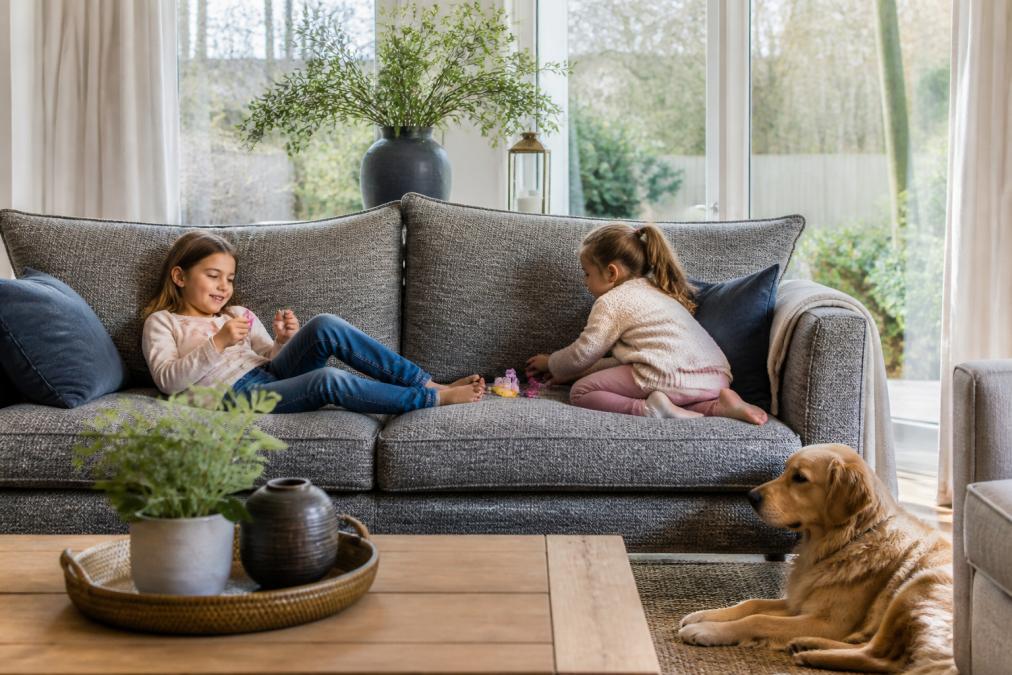
Darker shades and patterns hide stains better than light neutrals. Greys, charcoals, and patterns are practical. Light colours require tight weaves, proven stain resistance, and frequent cleaning.
Tight weaves are crucial: they keep spills on the surface longer, giving time to blot before stains set, while loose weaves allow liquids to penetrate, making stains permanent.
How to Clean High-Traffic Sofa Fabric Effectively
Address spills immediately by blotting (not rubbing) with a clean white cloth from the stain’s outside inward. For liquids, blot until no transfer occurs; for solids, dry completely before vacuuming.
Check your fabric’s cleaning code before cleaning: W (water-based cleaners), S (solvent-based only), WS (either), or X (vacuum only). Ignoring this can damage fabric or void warranties.
Performance polyester and polypropylene typically carry W or WS codes and accept water-based stain treatments. Traditional fluorocarbon treatments persist indefinitely; newer silicone alternatives break down faster but may need reapplication every few years. Ask manufacturers which treatment was used; some offer PFAS-free alternatives.
Natural fibres and wool blends carry S codes (solvent-based cleaners only), limiting options and requiring professional cleaning. Water-based cleaners cause felting or shrinking, and slow drying risks mildew.
Vacuum weekly with a soft brush attachment (not motorised) to remove dust, crumbs, and pet hair. For textured fabrics like chenille, vacuum in the direction of the nap.
For deeper cleaning, most W-code performance fabrics respond well to a mixture of mild detergent and water. Use a ratio of one part mild liquid detergent (such as wool wash or pH-neutral upholstery cleaner) to five parts water. Apply with a soft brush, working in circular motions, then extract with a damp cloth and clean water. Avoid over-wetting; the fabric should be damp, not soaked. Allow to air dry completely, ideally with good air circulation and mild heat (not direct sunlight, which can fade some fabrics). For stubborn stains, professional cleaning is often worth the investment, it’s cheaper than replacing a sofa and professionals have access to stronger solvents and extraction equipment.
Rotation helps distribute wear evenly. If your sofa has cushions that can be flipped or rotated, do so monthly. This prevents the same areas from bearing constant pressure and extends the visible life of the fabric. High-traffic seating areas will inevitably show wear patterns, but even distribution slows the process considerably.
One maintenance factor that varies dramatically by fabric type is how easily the fabric can be repaired if damage does occur. Performance polyester and polypropylene fabrics are relatively easy to patch because they’re widely available and durable enough to hold a patch securely. If a seam separates or a small tear appears, a professional upholsterer can often repair it without the repair being obvious. Natural fibres like linen and wool are harder to match and patch because colour variation between old and new fabric is more noticeable. Chenille fabrics can be patched, but the texture must be matched carefully. When choosing a fabric for a high-traffic sofa, consider not just how durable it is, but how easy it will be to repair when damage eventually occurs. A fabric that’s easy to patch extends the life of your sofa beyond the point where replacement might otherwise be necessary.
Real-World Performance: Lab Tests vs Everyday Wear
Here’s where the conversation gets honest. The Martindale rub test is useful, but it doesn’t tell the whole story about how fabric performs in your actual home. A fabric might achieve 50,000 double rubs in a laboratory and still look tired after three years of real use. Understanding why requires looking at what the lab test actually measures, and what it deliberately ignores.
The Martindale test measures abrasion resistance through controlled friction, but real homes introduce variables the test cannot replicate. Sunlight exposure causes different fading rates depending on window direction, glass type (UV-filtering windows slow fading), and seasonal angle changes. A south-facing window in summer creates far more intense UV stress than the standardised light source in laboratory conditions. Humidity fluctuations affect how quickly stains set into fibres and how easily they release during cleaning. In dry climates, spills may sit on the surface longer, giving you time to blot. In humid environments, liquids penetrate faster, making stains harder to remove even on high-Martindale fabrics.
Pilling, the formation of small balls of fibre on the surface, is another area where real-world performance diverges sharply from lab results. The Martindale test doesn’t specifically measure pilling resistance; a fabric can score 40,000 double rubs and still develop noticeable pilling within months of daily use. This happens because pilling results from fibre breakage and entanglement, which depends on fibre length, twist, and how the fabric is constructed, not just how many times it can be rubbed. Synthetic fibres like polyester and polypropylene resist pilling better than natural fibres, but blended fabrics, cotton-polyester mixes, for example, can pill unpredictably if the natural component is too short or loosely twisted.
Colour fastness is similarly underrepresented in Martindale testing. A dark grey performance polyester might maintain its Martindale rating whilst gradually developing a subtle sheen or slight colour shift over three years. This isn’t failure by the test’s definition, but it’s visible wear in your living room. Natural fibres and some synthetic blends fade more noticeably under UV exposure. Wool blends, despite their durability, can shift tone if exposed to strong sunlight without UV-protective window treatments. Performance polyester and polypropylene hold colour more consistently, which is one reason they dominate high-traffic recommendations.
Seam and edge wear represent another real-world failure mode the Martindale test doesn’t address. A sofa’s seams experience concentrated stress that’s different from the distributed friction the test applies. Seams can fray, pull, or separate before the fabric itself shows significant wear. This is why construction quality, thread type, seam density, and reinforcement, matters as much as fabric durability. A 40,000 double-rub fabric on a poorly constructed sofa will fail at the seams long before the fabric itself wears through.
Sagging and loss of structure occur gradually in real homes but aren’t measured by abrasion testing.
Selecting Your Sofa Fabric: A Practical Framework
Making the right choice requires balancing several factors. Start with your lifestyle. A quiet household with careful adults can accommodate delicate fabrics. A home with young children, pets, or frequent entertaining demands tougher material.
| Fabric Type | Martindale Rating | Best For | Key Consideration |
|---|---|---|---|
| Performance Polyester | 30,000-100,000+ | High-traffic homes with pets | Excellent stain resistance; may feel less breathable |
| Chenille | 20,000-50,000 | Busy households | Hides wear well; textured appearance |
| Linen Blend | 15,000-25,000 | Moderate use | Natural feel; requires more care |
| Wool Blend | 20,000-40,000 | Families without pets | Naturally stain-resistant; requires professional cleaning |
| Cotton | 10,000-20,000 | Light use | Comfortable; pills easily in high-traffic areas |
Frequently Asked Questions
What Martindale rub count do I need for a high-traffic sofa?
Sofas in active households should have a Martindale rub count of at least 15,000 double rubs; 20,000+ is ideal for families with children or pets. The Martindale rub test measures how many times fabric withstands rubbing before visible wear appears. Higher ratings indicate greater abrasion resistance and longer-lasting appearance in daily use.
Are synthetic fabrics better than natural fibres for durable sofas?
Synthetic fabrics typically outperform natural fibres in durability, stain resistance, and ease of cleaning. However, natural fibres offer better breathability and environmental credentials. Performance synthetics like polyester blends combine durability with comfort. The choice depends on your priorities: maximum durability and low maintenance favour synthetics, whilst environmental impact and breathability favour natural options.
Which fabrics are best for homes with pets?
Look for tight weaves with high Martindale ratings (20,000+), such as performance polyester, microfibre, or solution-dyed synthetics. These resist pet claws and stains better than loose weaves. Darker colours and patterned fabrics hide marks more effectively than light solids. Ensure the fabric has liquid-repellent treatment and avoid delicate natural fibres like linen that snag easily.
How often should I clean a high-traffic sofa fabric?
Vacuum weekly with an upholstery attachment to remove dust and prevent fibre matting. Spot-clean spills immediately with a damp cloth and mild detergent, testing on a hidden area first. Deep clean every 12-18 months using a professional upholstery cleaner or following the fabric’s specific cleaning code (typically marked as W, S, or WS). Regular maintenance extends the sofa’s lifespan and keeps it looking fresh.
