
Blog
Is Handcrafted Furniture Worth the Price? A Cost Breakdown
Sep
Table of Contents
- The Real Question: What Are You Actually Paying For?
- Cost Per Year: Handcrafted vs. Mass-Produced Furniture
- How to Spot Quality Furniture: Joinery and Materials
- Traditional Chesterfield Sofas: A Case Study in Longevity
- The Benefits of Bespoke Furniture: Beyond the Price Tag
- The Hidden Environmental Cost of Fast Furniture
- Maintenance and Restoration: The Economics of Repair
- Budget-Friendly Ways to Buy Handcrafted Pieces
- Frequently Asked Questions
Last Updated: September 6, 2026
The Real Question: What Are You Actually Paying For?
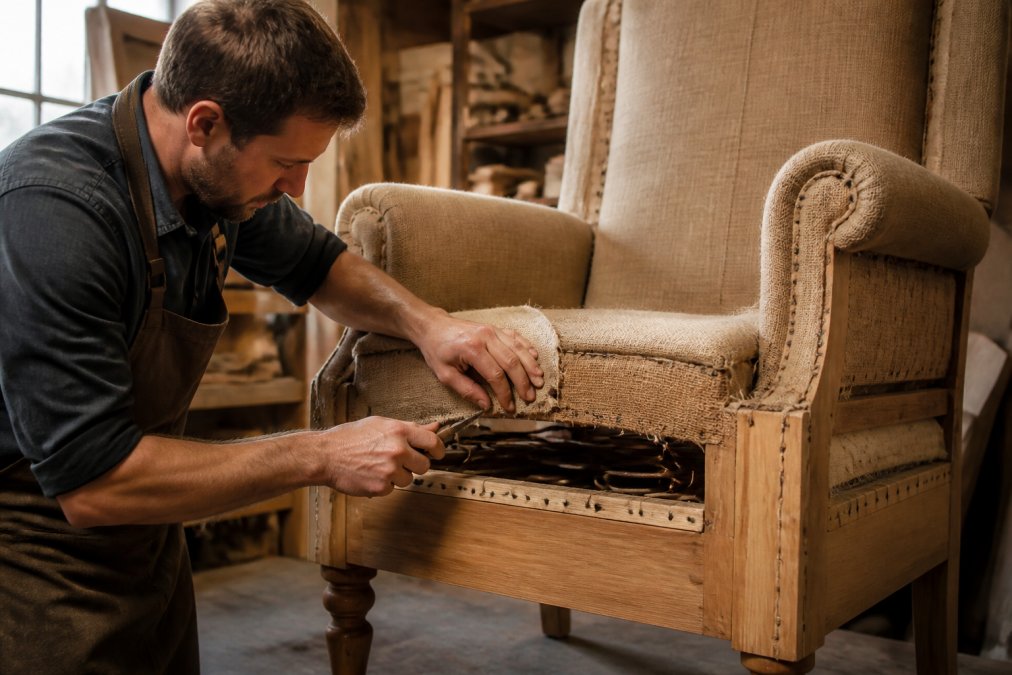
Ask most people why handcrafted furniture costs more, and they will say “the materials.” That answer misses the real distinction. The premium between a handmade piece and a high-street equivalent pays for something far scarcer than walnut or linen: skilled human hours. When you buy a handcrafted piece, you are funding the time of a maker who has spent years perfecting joinery, upholstery, and finish work that machines cannot replicate.
This guide breaks down the true economics of the decision, so you can judge whether handcrafted furniture is worth the price for your home. We will move past subjective opinions about style and focus on measurable value: cost per year, material integrity, and longevity. The answer, for most buyers, is a clear yes, but the reasoning matters more than the conclusion.
Handcrafted furniture is furniture built by skilled makers using traditional joinery and hand-finishing techniques, rather than assembled from particleboard and staples in a factory. That definition matters because it changes how you evaluate the purchase. You are not just buying an object; you are buying decades of service life.
Cost Per Year: Handcrafted vs. Mass-Produced Furniture
The fairest way to compare furniture is not by sticker price but by cost per year of service. A cheap sofa that collapses in five years is not a bargain; it is a rental with poor terms.
Consider two scenarios. A mass-produced sofa purchased for £800 might last five years before the frame creaks, the cushions flatten, and the fabric pills (which.co.uk). That works out to £160 per year. A handcrafted sofa at £2,000, built with a kiln-dried hardwood frame and traditional upholstery techniques, can reasonably serve twenty years or more. That is £100 per year, assuming no restoration. The handcrafted piece is cheaper by the year, and it will still look presentable when the disposable sofa is in a landfill.
The £2,000 Sofa: A 20-Year Investment
A properly built sofa with a solid hardwood frame, eight-way hand-tied springs, and high-density foam cushions is designed for reupholstery. When the fabric wears out in fifteen years, you can recover it for a fraction of the original cost. The frame and springs, the expensive parts, keep going.
The £800 High-Street Sofa: A 5-Year Disposable
The economics of mass-produced furniture assume you will replace it. Frames made from particleboard and MDF cannot be repaired economically. Stapled joints loosen. When the structure fails, the entire sofa is worthless. You do not restore a £800 sofa; you skip it to the tip and start again. This cycle is the hidden tax of cheap furniture.
| Comparison | Handcrafted Sofa | Mass-Produced Sofa |
|---|---|---|
| Typical upfront cost | Higher | Lower |
| Expected lifespan | 20+ years | 5-8 years |
| Frame material | Kiln-dried hardwood | Particleboard, MDF, plywood |
| Repair potential | Reupholstery and restoration | Not economical |
| Cost per year | Lower over time | Higher over time |
How to Spot Quality Furniture: Joinery and Materials
Knowing how to spot quality furniture protects you from paying handmade prices for factory goods dressed up with marketing. The evidence is in the joints and the materials, not the label. This section is a practical field guide, what to look for, what to avoid, and how to tell the difference in under five minutes.
The Five-Point Inspection Routine
1. Tip it sideways and check the frame.
Quality furniture is heavy because it uses solid hardwood, not because of added ballast. On a sofa, lift one corner. A handcrafted frame uses kiln-dried hardwood, typically beech, ash, or oak, with a minimum thickness of 25-30 mm at the joints. A mass-produced frame uses softwood (pine) or engineered wood (particleboard, MDF) that is lighter and visibly thinner. If you can see the frame through the dust cover, run your finger along it. Solid wood feels warm and has visible grain; particleboard feels cold and looks like compressed sawdust.
2. Look at the drawer construction.
On any cabinet or chest, pull the drawer all the way out and examine the front corners. A hand-cut or machine-cut dovetail joint shows interlocking wedge-shaped pins. On a quality piece, the pins and tails are tight, with no gaps and no glue squeezing out. A mass-produced drawer uses a butt joint, a simple square cut, reinforced with staples or screws, or a single dovetail slot cut into the side panel. If you see staples, the drawer was not built to be repaired; it was built to be replaced.
3. Check the back panel.
A quality cabinet has a back panel made of solid wood, held in place with screws in elongated holes that allow the wood to expand and contract with humidity. A disposable piece uses a thin sheet of plywood or hardboard, nailed into a groove. The difference is visible from the back: solid wood has grain and colour variation; hardboard is uniform, brownish, and often has a printed wood-grain pattern.
4. Examine the visible joints on a sofa frame.
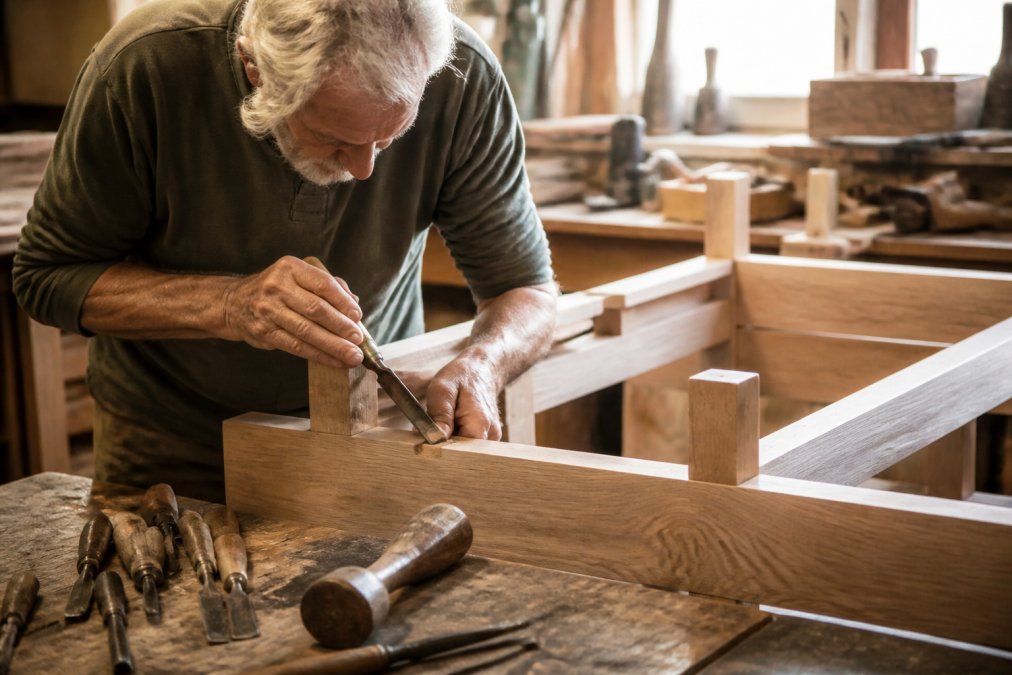
On a sofa, the critical joints are where the arm meets the front rail and where the back posts meet the seat rail. A quality frame uses a mortise-and-tenon joint, a projecting end (tenon) fitted into a socket (mortise), often reinforced with a wooden dowel or screw (woodmagazine.com). You can see this joint if you remove the dust cover underneath. A mass-produced frame uses a butt joint with a metal bracket or a staple-and-glue connection. The latter will loosen within five years; the former will outlast the upholstery.
5. Run your hand across every surface.
Hand-finished pieces feel smooth and even, with no rough edges, visible glue lines, or splinters. Run your hand along the underside of a table top and the inside of a drawer. Mass-produced pieces often skip sanding on hidden surfaces. A quality maker finishes every surface, because unfinished wood absorbs moisture unevenly and warps over time.
What the Joints Tell You About the Price
The joinery is not cosmetic; it is the structural argument for the price. A dovetail joint mechanically locks two boards together, so the joint does not rely on glue alone. It accommodates the natural expansion and contraction of wood as humidity changes. A butt joint with staples does not, it loosens, creaks, and eventually fails.
Here is a quick reference for what you are likely to find:
| Joint or Construction | What It Signals | Typical Lifespan |
|---|---|---|
| Hand-cut dovetail | Master craftsman, heirloom quality | 50+ years |
| Machine-cut dovetail | Quality factory or production workshop | 20-30 years |
| Mortise and tenon (pegged) | Traditional frame construction | 30+ years |
| Mortise and tenon (glued) | Good factory construction | 15-25 years |
| Butt joint with staples | Mass production, disposable | 3-8 years |
| Butt joint with screws | Mass production, slightly better | 5-10 years |
A common mistake is confusing “solid wood” with “solid construction.” A table top made of solid oak can still sit on legs attached with a single screw. Always inspect how the parts connect, not just what the surface is made of. The joinery is the evidence; the material is only the promise.
The ‘Hidden’ Test: Knock on It
Quality makers use solid wood panels. Mass producers use veneered particleboard. The difference is audible. Knock on the side panel of a cabinet or the seat deck of a sofa. Solid wood produces a dull, solid thud. Particleboard produces a hollow, high-pitched sound. This is not a parlor trick; it is a reliable acoustic test that takes two seconds and requires no disassembly.
Traditional Chesterfield Sofas: A Case Study in Longevity
Traditional chesterfield sofas offer the clearest example of why quality construction outlasts trends. The deep buttoning, rolled arms, and equestrian-inspired design have remained in production for over two centuries because the construction method is inherently durable.
A genuine chesterfield is built on a solid hardwood frame with no softwood substitutes. The seat uses coil springs tied by hand, not webbing that sags within a decade. The leather is typically a full-grain hide, chosen to develop a patina over decades rather than peel like corrected-grain leather. This is heirloom quality, furniture designed to be passed down rather than replaced. When you compare a traditional chesterfield against a mass-produced interpretation, the differences in frame weight, spring tension, and leather thickness are immediately apparent.
The Benefits of Bespoke Furniture: Beyond the Price Tag
The benefits of bespoke furniture extend far beyond durability. A custom piece is designed around your space, your body, and your aesthetic, which changes how the furniture functions in daily life.
Mass-produced sofas are engineered for the average person. Bespoke design accounts for the fact that no one is average. Seat depth, back height, and arm position can be adjusted to your proportions, which directly affects comfort over a twenty-year ownership period. Ergonomics is not a luxury; it is a health consideration for anyone who spends significant time seated.
Custom Specification and Ergonomics
Custom specification also solves practical problems that off-the-shelf furniture cannot. An alcove of an unusual depth, a room that demands a specific fabric to match existing pieces, or a corner configuration that standard ranges do not offer. At Artisan sofas, our role is to guide you through these decisions, helping you navigate every fabric, leather, and collection to ensure the piece fits your renovation perfectly. This personal guidance is part of the value, reducing the risk of a costly mistake.
Bespoke furniture is not about indulgence. It is about getting a piece that fits your body and your room precisely, which eliminates the compromises that lead to early replacement.
The Hidden Environmental Cost of Fast Furniture
The environmental argument for handcrafted furniture is not about the romance of the workshop; it is about waste arithmetic. Fast furniture is designed for a short lifecycle, and that lifecycle ends in a landfill.
The hidden environmental cost appears across the furniture lifecycle. Mass-produced pieces use particleboard and MDF, which contain adhesives that make recycling difficult (the EPA). The wood grain you see on the surface is often a printed veneer over a composite core. When the piece breaks, it cannot be repaired, repurposed, or easily recycled. Contrast that with a solid wood piece that can be refinished, reupholstered, and ultimately broken down into raw timber. Sustainability in furniture is not about the origin of the wood alone; it is about how long the piece stays in service and what happens when it is finally retired.
Maintenance and Restoration: The Economics of Repair
The economics of repair favour quality construction in a way that most buyers never consider. A handcrafted sofa can be reupholstered several times over its life, effectively giving you a new piece of furniture for a fraction of the replacement cost.
Restoration is only viable when the underlying structure is sound. A hardwood frame with traditional joinery can be tightened, refinished, and re-covered. The investment piece retains its value because the skeleton is worth preserving. Mass-produced furniture offers no such path. When the foam degrades or the frame joint fails, repair costs exceed replacement value. This is the maintenance reality that separates an investment piece from a disposable good. Before you buy, ask whether the piece could be restored in twenty years. If the answer is no, you are not buying furniture; you are buying temporary seating.
Budget-Friendly Ways to Buy Handcrafted Pieces
Quality does not have to mean paying full retail on day one. Several practical routes let you acquire handcrafted furniture without stretching beyond your budget.
Consider these approaches:
- Buy once, buy well, and prioritise. Instead of furnishing a whole room at once, buy the single most-used piece first, a sofa or bed, and live with temporary alternatives elsewhere.
- Shop ex-display and clearance. Retailers occasionally sell floor samples and discontinued fabrics at a discount. The construction is identical; only the finish differs.
- Invest in restoration projects. Auction houses and salvage yards regularly sell solid wood pieces needing reupholstery or refinishing. The cost of the piece plus restoration often lands well below the retail price of an equivalent new item.
- Choose timeless over trendy. A classic silhouette in a neutral fabric will not date, which protects your investment against the urge to replace it in five years.
The throughline across these strategies is the same: handcrafted furniture is worth the price because it is the only furniture that can be repaired, restored, and inherited. Mass-produced alternatives offer a lower upfront cost but a higher cost per year, no repair path, and a guaranteed trip to the landfill. When you choose a handcrafted piece, you are making a financial decision that pays dividends in comfort, longevity, and sustainability.
Frequently Asked Questions
Is bespoke furniture better quality than mass-produced alternatives?
Yes, in most cases. Bespoke furniture is built with hardwood frames, traditional joinery like dovetail or mortise and tenon joints, and hand-finished details. Mass-produced pieces often rely on particleboard, MDF, and staples that fail within a decade. The material integrity and structural integrity of a handmade piece allow it to be repaired and reupholstered, extending its furniture lifecycle significantly.
Is it worth investing in traditional chesterfield sofas?
For many buyers, yes. A traditional chesterfield sofa with a solid hardwood frame and hand-tied springs can last 20 years or more. When you divide the upfront cost by its lifespan, the cost-per-year often beats replacing a high-street sofa every five years. They also hold resale value better than mass-produced designs.
How can you identify high-quality craftsmanship in wooden furniture?
Look for dovetail joints in drawers and mortise and tenon joints in frames. Check that the wood grain is consistent and that the piece is made of solid wood, not veneered particleboard. High-quality pieces will feel heavy and stable. The finish quality should be smooth and even, with no visible glue or staples.
Choosing between a disposable sofa and a long-term investment comes down to how you value your money and your time. The team at Artisan sofas brings over 50 years of craftsmanship to every conversation, offering expert, personal guidance on fabric, leather, and collections from the renowned Tetrad brand. Our professional white glove service delivers your piece directly to your door, positioned exactly where you want it. Explore the collection and find the piece that will outlast every trend.
