
Blog
How to Choose Upholstery for Period Homes
Oct
Table of Contents
- Understanding Your Home’s Architectural Character
- Upholstery Fabrics for Period Homes: Natural Fibres and Weaves
- Victorian Sofa Upholstery Ideas: Colour and Pattern Selection
- How to Match Upholstery to Period Features
- Best Durable Upholstery Fabrics for Sofas: Durability and Performance
- Fire Safety Regulations and Fabric Compliance
- Caring for Your Upholstered Furniture Long-Term
- Your Practical Selection Workflow
- Step 1: Assess your room’s light and existing palette
- Step 2: Identify the furniture style and frame shape that suits the period
- Step 3: Request and compare fabric samples at home
- Step 4: Confirm durability ratings and care requirements
- Step 5: Finalise your choice and discuss fabric quantities with your upholsterer
- Frequently Asked Questions
Last Updated: October 19, 2026
Understanding Your Home’s Architectural Character
Choosing upholstery for period homes starts with architectural character, cornicing, sash windows and original plasterwork should guide every fabric decision.
A Georgian townhouse speaks differently than a Victorian villa or an Arts and Crafts bungalow. Walk through your rooms first, original features are design anchors, not obstacles.
Period features and original details
Cornicing, ceiling roses, fireplaces, sash windows and original skirtings create an aesthetic your upholstery should respect, not fight against.
Fabric either complements these features or competes with them. A bold damask might enhance a Victorian parlour with heavy cornicing but overwhelm a minimalist 1950s interior. Room scale, ceiling height and the prominence of original details all matter.
Document what you have: photograph cornicing, window frames and original elements, and note proportions, tall ceilings or modest ones shape fabric weight, pattern scale and colour intensity.
How fabric choices affect the overall aesthetic
Upholstery is one of the largest visual elements in any room: when fabric works with period features the room feels cohesive; when it clashes, the disharmony is obvious.
The right fabric makes original features feel intentional and valued; poor choices make them feel dated.
Colour, pattern, weave and texture all influence how a room feels: a heavy wool velvet in deep burgundy speaks of formality; a lightweight neutral linen suggests restraint. Neither is wrong, but one will feel right for your home.
Upholstery Fabrics for Period Homes: Natural Fibres and Weaves
Natural fibres, wool, linen and cotton, have been used in upholstery for centuries, and they age gracefully and feel substantial in a way synthetics often don’t.
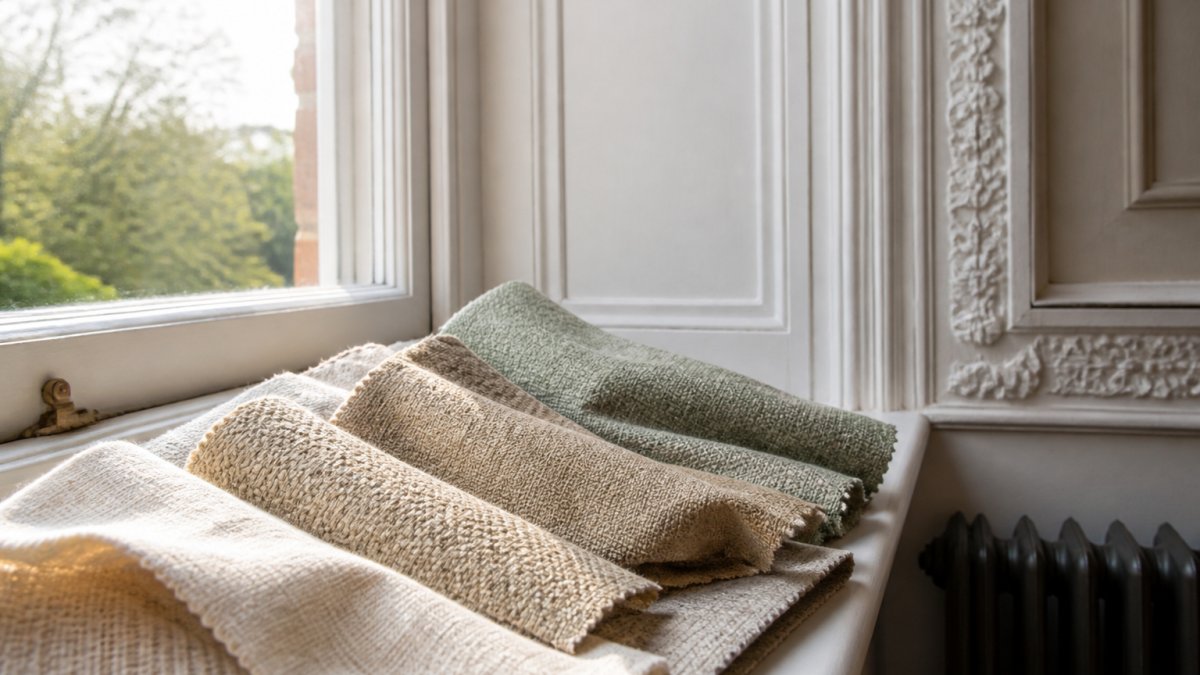
Wool, linen and cotton-linen blends
Wool is the workhorse of period upholstery. It’s naturally resilient, resists staining better than most fibres, and develops a soft patina over time.
Wool’s natural crimp and elasticity mean it bounces back after use, a daily-use wool sofa will look better after ten years than a synthetic alternative.
Linen is lighter and more casual than wool. It wrinkles easily, part of its charm in period homes, where that lived-in quality suits traditional interiors.
The drawback: linen stains easily. In high-traffic homes with children or pets, pure linen is risky.
Traditional weaves: damask, brocade, tapestry and tweed
Each of these weaves has distinct characteristics that suit different spaces.
Damask is a jacquard weave with a raised pattern, formal, elegant and instantly traditional.
Brocade is richer and more ornate than damask, often with metallic threads.
Tapestry weaves tell stories through intricate, multi-coloured patterns. They suit traditional country homes and period cottages, but are visually busy, pair them with simpler fabrics elsewhere in the room.
Tweed is sturdy, textured and distinctly British. It suits Arts and Crafts homes, Scottish period properties and any rural or country aesthetic, ageing beautifully and softening with use.
Victorian Sofa Upholstery Ideas: Colour and Pattern Selection
Victorian homes demand bold decisions. This era celebrated colour, pattern, and richness. Your Victorian sofa upholstery should reflect that confidence.
Bold colours and traditional palettes
Victorians weren’t afraid of colour: deep jewel tones, burgundy, forest green, navy and rich purple, dominated period interiors and still work beautifully today.
Neutral upholstery is a modern choice, not wrong, but it misses an opportunity. If you’re hesitant about colour, remember upholstery can always be changed; walls and architectural features are permanent.
Consider the room’s light. North-facing Victorian rooms feel cold with cool colours. Warm burgundies, terracottas, and deep golds add warmth.
Pattern scale and balancing multiple designs
Victorian interiors mixed patterns confidently. A damask sofa, patterned curtains, and patterned wallpaper could coexist because the patterns were chosen thoughtfully.
The key is pattern scale variation: a large, bold wallpaper calls for a smaller-scale sofa pattern; medium geometric curtains pair with a finely detailed damask or brocade.
Solid colours are your allies: a solid armchair next to a patterned sofa prevents overwhelm, and a solid rug grounds patterned furniture.
How to Match Upholstery to Period Features
Your period features deserve upholstery that respects them. This isn’t about matching exactly, it’s about creating visual harmony.
Coordinating with cornicing, sash windows and original details
Cornicing draws the eye upward, so ornate plasterwork needs upholstery substantial enough to balance it, a substantial wool, structured damask or textured tweed.
Sash windows frame views and light, and their proportions influence furniture scale: large sash windows suit larger upholstered pieces, smaller windows suit more modest proportions.
Original fireplaces are focal points. If yours is grand and detailed, position your sofa to face it and choose upholstery that complements its colour and style, cream stone pairs beautifully with neutral linen, dark brick with deep jewel tones.
The role of fabric samples in decision-making
Never choose upholstery fabric from a small swatch or a photograph. Fabric changes dramatically at different scales and in different light.
Request large samples, at least 30 by 30 centimetres, and place them next to your existing furniture, walls and architectural features.
Show samples to your chosen professional, whose eye can catch potential issues with pattern matching, seaming or durability that aren’t obvious to the untrained eye.
Best Durable Upholstery Fabrics for Sofas: Durability and Performance
Durability matters for daily-use sofas, a beautiful fabric that falls apart after two years isn’t a bargain. Understanding durability metrics helps you choose well.
Understanding rub counts and abrasion resistance
Rub count measures how many times fabric can be rubbed with a standardised tool before showing wear, in Martindale cycles. Higher numbers mean greater durability.
Wool typically rates 15,000-50,000 cycles depending on weave; linen usually 10,000-20,000; cotton-linen blends often exceed 25,000. Synthetics can rate higher, but natural fibres offer other advantages that offset slightly lower counts.
Abrasion resistance is how the surface holds up to friction: tight weaves resist better than loose ones, and smooth surfaces show wear less obviously than textured ones.
Tight weaves and high-use furniture
Tight weaves are your friend for durable upholstery, they resist pilling, snagging and general wear. Damask, brocade and quality tweed are typically tight weaves.
Loose weaves like some linens and cottons are beautiful but less durable. They’re better suited to occasional-use furniture, a bedroom chair rather than a family room sofa.
Frame construction matters as much as fabric: a well-built frame will outlast any fabric. At Tetrad sofas.
Fire Safety Regulations and Fabric Compliance
Upholstered furniture sold in the United Kingdom must meet fire safety standards, it isn’t optional.
The Furniture and Furnishings (Fire) (Safety) Regulations 1988 sets mandatory requirements. All upholstered furniture must pass specific fire tests. Your upholsterer and fabric supplier should confirm compliance before you order.
Most quality fabrics meet these standards. However, some beautiful period-appropriate fabrics, particularly antique or vintage textiles, may not.
Don’t let fire safety compliance discourage natural fibres: wool is naturally flame-resistant, and linen and cotton can be treated to meet standards.
Caring for Your Upholstered Furniture Long-Term
Proper care extends your upholstery’s life significantly. Different fabrics require different approaches.
Cleaning and maintenance by fabric type
Wool is relatively forgiving. Vacuum regularly with an upholstery attachment. For spills, blot immediately with a clean cloth. Wool’s natural oils help repel moisture.
Damask, brocade and tapestry need gentle care: vacuum with a soft brush attachment, avoid water-based cleaning, and use professional dry cleaning for these delicate weaves.
Rotate cushions every few months, they settle unevenly with use, and rotating distributes wear evenly and extends their life.
Sustainability and material provenance
Choosing natural fibres supports sustainability: wool is renewable and biodegradable, linen and cotton are plant-based and compostable, and all have minimal environmental impact compared to synthetics.
Consider fabric provenance when possible. Fabrics made locally or regionally reduce transportation impact. British wool and linen production supports local industries and reduces carbon footprints.
Durable, timeless upholstery is inherently sustainable: furniture that lasts decades doesn’t need replacing, so a well-made sofa in quality natural fibre beats a cheap synthetic alternative replaced every five years.
Your Practical Selection Workflow
Choosing upholstery for a period home feels overwhelming. A structured approach simplifies the process.
Step 1: Assess your room’s light and existing palette
Spend time in your room at different times of day and notice how light changes it: north-facing rooms feel cool and need warm fabrics, while bright south-facing rooms can handle cool tones.
Document your existing palette. Photograph your walls, curtains, and architectural features. Note dominant colours and secondary accents. Your upholstery should complement, not clash with, what’s already there.
Step 2: Identify the furniture style and frame shape that suits the period
Different periods favour different furniture shapes. Victorian sofas are often deep and low-slung. Georgian pieces are more structured and formal. Arts and Crafts furniture emphasises simple, honest lines.
Research your home’s period and period-appropriate furniture styles, noticing frame shapes, leg styles and proportions. Your sofa’s silhouette should echo your home’s character.
Step 3: Request and compare fabric samples at home
Request large samples, at least 30 by 30 centimetres, of multiple fabrics you’re considering so you can compare.
Bring samples home and place them against your walls, existing furniture and architectural features. View them in natural and artificial light, and live with them for several days.
Step 4: Confirm durability ratings and care requirements
Before finalising, confirm the fabric’s rub count and durability rating, ask your upholsterer about care requirements, and understand how it will age and what maintenance it needs.
Confirm fire safety compliance. Verify that your chosen fabric meets current regulations.
Step 5: Finalise your choice and discuss fabric quantities with your upholsterer
Once you’ve decided, discuss fabric quantities with your chosen professional: a sofa needs more than an armchair, and pattern matching requires additional fabric.
Your chosen professional will calculate exact requirements based on your furniture’s dimensions and your fabric’s pattern repeat. Discuss delivery timelines. Quality upholstery takes time. Allow adequate lead time for ordering, manufacturing, and delivery.
Choosing upholstery for a period home rewards patience and attention. Your home’s architectural character, cornicing, sash windows and original features, deserves upholstery that honours those details.
At Tetrad sofas. Tetrad chairs., we specialise in handcrafted British furniture that respects period architecture. We’ve built sofas and chairs for over 50 years, and we know how to match quality upholstery to homes with genuine character. EXPLORE COLLECTION to discover how we can help you find the perfect upholstery for your period home.
Frequently Asked Questions
How do I choose upholstery fabric that suits my period home’s character?
Start by identifying your home’s architectural era and original features such as cornicing, sash windows and fireplaces. Select natural fibres like wool, linen or cotton-linen blends that complement the period’s aesthetic. Request fabric samples and view them in your room’s light before committing. Consider the colour palette and pattern scale that suit your existing features, and confirm the fabric’s durability rating matches your furniture’s intended use.
What are the best durable upholstery fabrics for period home sofas?
Wool, tight-weave linen and cotton-linen blends offer excellent durability for high-use furniture. Look for fabrics with a Martindale rub count of at least 15,000 for everyday sofas. Traditional weaves such as damask, brocade and tweed combine period authenticity with longevity. Request the fabric’s abrasion resistance rating and care instructions from your chosen professional to ensure the piece will age well.
Should I match my sofa upholstery to my curtains in a period home?
Not necessarily. Coordinate your colour palette and fabric weight rather than matching exactly. A sofa in a complementary colour can enhance the room’s character while curtains draw the eye upward to period cornicing and windows. Use fabric samples to test combinations in natural light. Bold patterns on both pieces can work if the scale differs, but consider balancing a patterned sofa with solid curtains or vice versa.
What fire safety standards apply to upholstered furniture in period homes?
Upholstered furniture sold in the UK must comply with the Furniture and Furnishings (Fire Safety) Regulations 1988. All upholstery fabrics must meet specific flammability standards. Your retailer should provide documentation confirming compliance. This is particularly important for period homes where fire safety may be overlooked; modern upholstery standards protect your investment without compromising aesthetic authenticity.
