
Blog
How to Choose Upholstery Fabric Online: A 2026 Guide
Sep
Table of Contents
- Start With the Martindale Rub Test Explained
- How to Request Fabric Samples Before You Buy
- The Best Upholstery Fabric for Pets and Children
- Understanding Weave, Thread Count and Abrasion Resistance
- How to Choose Upholstery Fabric Online: Colour, Texture and Drape
- Calculating How Much Fabric You Need for Your Project
- Sustainability, Safety and What to Check Before You Order
- Frequently Asked Questions
Last Updated: September 11, 2026
Start With the Martindale Rub Test Explained
The Martindale rub test is the single most useful number on any upholstery specification, and it measures abrasion resistance: how many rubs a fabric withstands before showing visible wear. Understanding how to choose upholstery fabric online starts here, because it is the one figure that separates a sofa built for a busy family from one destined for a spare room.
What the Numbers Actually Mean for Your Home
The scale runs from roughly 10,000 rubs (decorative use only) to 40,000 and beyond for heavy domestic and commercial grade upholstery. A general guide:
| Rub Count | Suitable For |
|---|---|
| 10,000-15,000 | Occasional chairs, bedrooms |
| 15,000-25,000 | Light-use living rooms |
| 25,000-30,000 | General domestic use |
| 30,000+ | Busy family homes, pets |
A high rub count does not mean a fabric is indestructible. Abrasion resistance says nothing about stain resistance or colour fastness, and a loosely woven 40,000-rub fabric can snag long before a tight 25,000-rub weave shows any wear.
How to Request Fabric Samples Before You Buy
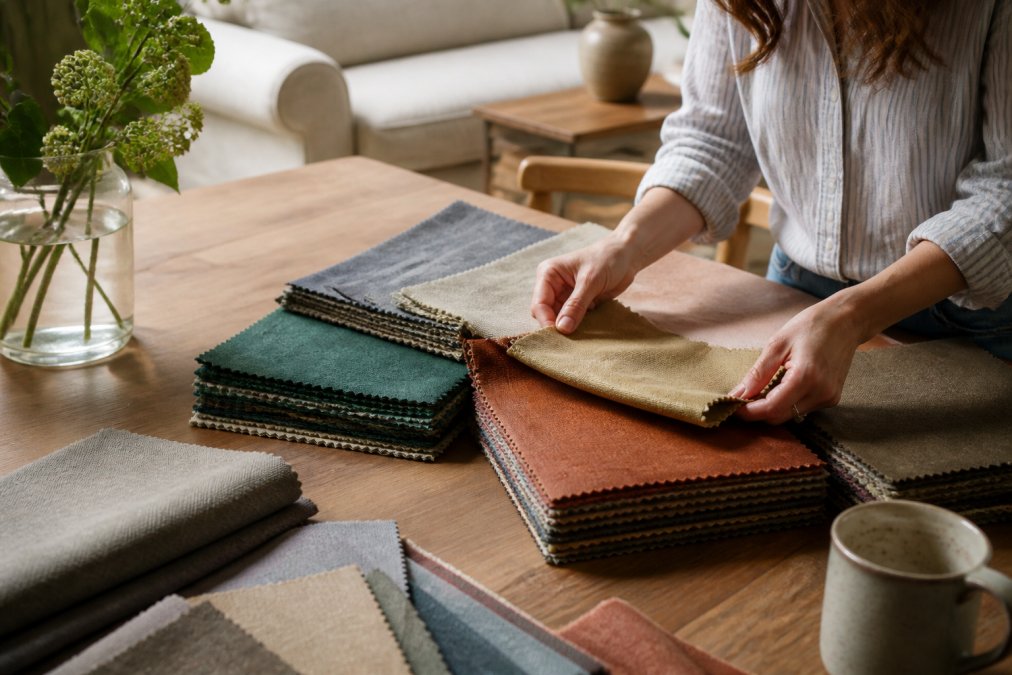
Always request physical fabric samples before committing, and test them in your own home rather than relying on a screen. This is the step most online buyers skip, and it is the one that prevents expensive mistakes. Colour on a monitor is never accurate, and texture is impossible to judge digitally.
Testing Samples in Your Own Light
Place each swatch against your existing furniture and flooring, then check it at different times of day. North-facing rooms pull colours cooler; evening lamplight warms them considerably. Rub the sample between your fingers to assess drape and pile, and hold it at arm’s length to judge how the pattern repeat reads across a whole sofa.
The Best Upholstery Fabric for Pets and Children
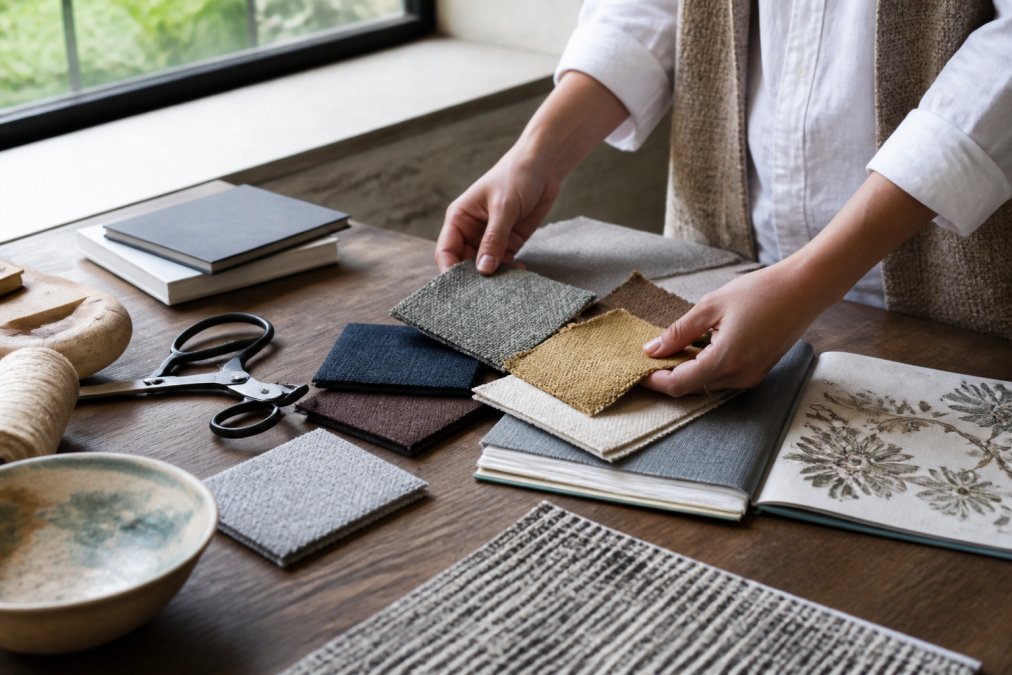
Most guides stop at “choose something durable” and leave you no closer to a decision. The useful version of this question is narrower: which specific fabric constructions survive claws, spills and repeated cleaning in a busy household, and which only look as though they will?
Named fabrics that genuinely perform
- Performance velvet. A dense, short-pile velvet woven from polyester or a polyester-cotton blend. The pile is too short for claws to hook, and the tight construction resists the pilling that ruins cheaper velvets. It is the single most requested choice for households with cats, and it hides the flattened patches that show on natural-fibre velvet.
- Microfibre and microfibre blends. Extremely fine synthetic yarns woven tightly, giving a smooth surface that spills sit on rather than soak into. Most wipe clean with a damp cloth, and the tight weave means claws skate across rather than catch.
- Tightly woven synthetic blends (polyester, acrylic, olefin). These resist fading, hold shape under repeated cleaning, and are usually the cheapest genuinely hard-wearing option. The trade-off is a flatter, less characterful look than natural fibres.
- Leather and bonded leather. Wipe-clean and claw-resistant in the sense that claws do not snag, though sharp claws can scratch the surface. Scratches on a full-grain hide often blend into the natural grain; on bonded leather they tend to stay visible.
- Crypton-style and stain-resistant finished fabrics. A finish applied to the yarn or the fabric face that repels liquids before they penetrate. Effective, but the finish can diminish with aggressive cleaning, so follow the care code.
Fabrics to avoid in a pet-heavy or child-heavy home
- Loose weaves and open basketweaves. Claws and small fingers catch in the gaps and pull threads.
- Long-pile and shag fabrics. Impossible to clean properly and they trap everything.
- Delicate natural fibres such as silk, viscose and some linens. They mark, pill and stain readily, and many are not cleanable with water.
- Light, solid-colour fabrics in high-traffic rooms. They show every mark, however well they are made.
How to test a swatch before you commit
A swatch is a free experiment. Before ordering, do all of the following on the sample, not on the sofa:
- Scratch test. Drag a key or a pet comb across the weave at an angle. A fabric that snags or pulls a thread will do the same on day one.
- Spill test. Drip a small amount of water, then a small amount of coffee or wine, and blot. Note whether the liquid beads, sits on the surface, or soaks straight in.
- Abrasion test. Rub the swatch firmly against a hard edge fifty times and check for pilling or thinning.
- Clean test. Follow the fabric’s cleaning code and see whether the mark lifts without leaving a ring.
Ask for a Martindale rating of 30,000 or above, confirm the cleaning code, and request a swatch you can deliberately scratch and spill on before ordering. A retailer confident in their fabric will never hesitate over this request.
The trade-offs nobody mentions
No fabric wins on every measure. Performance velvet and microfibre resist claws and clean easily but can feel warmer and less breathable than linen. Tight synthetics are hard-wearing but show a flatter, more uniform surface. Leather wipes clean but scratches. The right answer depends on which failure mode you can live with: a visible scratch, a stubborn stain, or a snagged thread. Decide that first, then choose the fabric that fails in the way you can tolerate.
For households with both pets and young children, the practical default is a tightly woven synthetic blend or performance velvet in a mid-tone or patterned design, with removable covers where the frame allows. That combination handles claws, spills and repeated cleaning without asking you to redecorate the room around it.
Understanding Weave, Thread Count and Abrasion Resistance
Thread count matters far less in upholstery than it does in bedding, and treating it as the headline metric is a common mistake. What matters is weave density and tensile strength: how tightly the yarns interlock and how much force they withstand before distorting. A plain weave, such as a linen or cotton blend, offers breathability and a clean look but shows wear sooner. Twills and jacquards pack yarns more densely, which improves durability and hides marks.
Natural fibres bring texture and character but generally need more care. Synthetic fibres, and blends of the two, add resilience and colour fastness. The right answer depends on the room, not on a single “best” fibre.
How to Choose Upholstery Fabric Online: Colour, Texture and Drape
Learning how to choose upholstery fabric online comes down to three visual decisions: colour, texture and drape. Get these right and the sofa looks intentional in the room rather than merely expensive.
Matching Colour and Pattern to Your Room
Start with what already exists. Pull one or two tones from your rug, artwork or walls and let the sofa sit within that palette rather than dominate it. Large pattern repeats suit generous rooms; small-scale patterns work better in compact spaces. Check pattern repeat measurements before ordering, because a bold repeat consumes more fabric and changes the yardage calculation.
Texture adds depth that flat colour cannot. A boucle or velvet introduces contrast against plain walls, while a smooth weave keeps a patterned room calm.
Calculating How Much Fabric You Need for Your Project
This is the step most online guides skip entirely, and it is where online orders most often go wrong. The maths is simpler than it looks, and getting it right the first time avoids the worst outcome in upholstery: running short of a dye lot that has since sold out.
The basic formula
For each panel to be covered, work out:
Panel fabric = (panel width + seam allowance) × (panel height + seam allowance)
Then add pattern repeat, then add a waste margin, then sum every panel.
Step by step
- Measure every panel separately. Seat, back, arms, outside arms, front rail, and each cushion front, back and sides. Do not estimate from the sofa’s overall dimensions, the panels add up to more than the footprint.
- Add seam allowance. A common allowance is 2.5 cm per edge, so add 5 cm to both the width and the height of each panel (sewing.org). Confirm this with your upholsterer, as allowances vary.
- Add pattern repeat. For a repeating design, add one full pattern repeat to the height of each panel, and if the repeat is large, add one repeat to the width as well. A 64 cm repeat on a 90 cm panel can push you into a second drop.
- Add a waste margin. Add 10-15% for plain fabrics and 15-20% for patterned or striped fabrics, which need more matching.
- Confirm the fabric width. Upholstery rolls commonly come in 137 cm and 140 cm widths, but some are narrower. A narrower roll means more drops and more waste.
- Round up, never down. Order to the nearest half metre above your total.
A worked example
Take a two-seat sofa with a plain fabric and a 137 cm roll:
- Seat panel: 150 cm × 70 cm → with 5 cm seam allowance, 155 cm × 75 cm
- Back panel: 150 cm × 80 cm → 155 cm × 85 cm
- Two arms: 90 cm × 70 cm each → 95 cm × 75 cm each
- Two seat cushions, front/back/sides: roughly 150 cm × 60 cm each → 155 cm × 65 cm each
- Front rail: 150 cm × 30 cm → 155 cm × 35 cm
Add these up and you land in the region of 6-7 metres of usable fabric. Add 15% waste and you are ordering around 7.5-8 metres. With a large pattern repeat, add a further repeat per panel and you may need 9 metres or more.
Why pattern repeat changes everything
A bold repeat is not just a visual choice; it is a cost decision. A 64 cm repeat on a 90 cm panel means each drop effectively consumes 154 cm of fabric, not 90 cm. On a sofa with six drops, that is an extra 3.8 metres before you have added any waste margin. Always check the repeat measurement on the fabric specification before you calculate.
Quick reference
| Fabric type | Waste margin to add |
|---|---|
| Plain, no repeat | 10-15% |
| Small repeat (under 20 cm) | 15% |
| Large repeat (over 40 cm) | 15-20% |
| Stripes or checks needing matching | 20% |
Never round down. Ordering a little extra costs far less than discovering mid-project that you are half a metre short of a dye lot that has since sold out. If in doubt, order one extra metre and keep it for future repairs.
If your retailer offers a fabric calculator or a measuring service, use it, but check the output against your own figures. The formula above is the same one most upholsterers use, and running it yourself is the surest way to avoid the shortfall that turns a straightforward project into a delay.
Sustainability, Safety and What to Check Before You Order
Two checks belong on every order: fire retardancy compliance and cleaning codes. Upholstered furniture sold domestically must meet UK fire safety regulations, and a reputable retailer will confirm this without prompting (gov.uk). Cleaning codes tell you whether a fabric tolerates water-based or solvent cleaners, which determines how practical it will be long term.
Sustainability claims deserve scrutiny too. Look for recognised eco-certifications and ask where the fibre was sourced. As the UK government guidance on furniture fire safety sets out, compliance is a legal requirement, not a premium extra, and any retailer unable to confirm it is one to avoid.
Ask directly whether the fabric carries an eco-certification and request the certificate. Vague references to “sustainable materials” without documentation mean very little.
Virtual visualisation tools now let you preview a fabric on a specific sofa model before ordering, which closes much of the gap between showroom and screen. Combine that with physical samples and you have the closest thing to sitting on the finished piece.
Choosing upholstery fabric online asks you to trust measurements, ratings and swatches rather than your hands on the finished sofa. That is a reasonable trade when the retailer guides you properly through every stage. At Artisan Sofas, our team offers personal guidance across every fabric and leather in the Tetrad collection, backed by over 50 years of British craftsmanship, physical samples sent to your door, and a white glove delivery service. Explore the collection and find the fabric that suits your home.
Frequently Asked Questions
How do I ensure the colour of upholstery fabric is accurate when buying online?
Screens vary, so the colour you see online may differ slightly from the physical fabric. Always order samples first and view them in your own home under both natural and artificial light. Place the swatch next to your existing furniture, curtains and flooring. If you need help, ask the retailer for guidance. A specialist like Artisan Sofas can advise on how a specific fabric will look in your space.
What is the Martindale rub test and why does it matter for sofa fabric?
The Martindale rub test measures how well a fabric resists abrasion by rubbing it against a standard abrasive material until it shows wear. The result is expressed as a rub count. For general domestic use, a fabric should reach at least 20,000 rubs. Busy family homes need 25,000 to 30,000 rubs. The higher the number, the more durable the upholstery fabric will be over time.
How do I request fabric samples to test at home?
Most online upholstery retailers let you order samples directly from the product page. Select the fabrics you are considering and request a swatch. When the samples arrive, view them in the room where the furniture will live. Check how the colour shifts in morning and evening light. Feel the texture against your skin. Compare the weight and drape. This simple step prevents costly mistakes when buying upholstery fabric online.
What is the best upholstery fabric for pets and children?
Look for tightly woven synthetic blends or leather. Fabrics with a high Martindale rub count (30,000 or above) handle daily wear better. Microfibre and performance weaves resist stains and are easy to clean. Avoid loose weaves and light-coloured natural fibres that show marks quickly. Always check the cleaning code before you buy. A fabric that can be wiped clean will save you time and stress in a busy household.
How can I tell if an upholstery fabric is high quality before purchasing?
Check the rub count, the weave density and the fabric weight. A high-quality upholstery fabric feels substantial and holds its shape when you scrunch it. Look for tight, even weaving with no loose threads. Ask about the fibre composition. Natural fibres like wool and cotton offer breathability, while synthetics add strength. Request a sample so you can assess texture, drape and colour fastness yourself before committing.
What are the trends in sofa fabric for 2026?
Boucle, textured weaves and muted earth tones remain popular. There is growing demand for sustainable fabrics made from recycled fibres and naturally dyed yarns. Performance fabrics that mimic the look of linen but resist stains are also gaining ground. Velvet continues to feature in statement pieces. The key trend is balancing aesthetics with practicality, so choose a fabric that suits how you actually live in your home.
