
Blog
Best Handcrafted Sofas for Modern Homes: 2026 Guide
Sep
Table of Contents
- Quick Comparison: Best Handcrafted Sofas for Modern Homes
- Tetrad Harris Tweed Collection: Heritage Meets Modern
- Sofa.com The Bluebell Sofa: Customisable Comfort
- Loaf The Slowcoach Sofa: Relaxed Modern Living
- Ercol Romana Sofa: Mid-Century Craftsmanship
- John Lewis Croft Collection: Accessible Handcrafted Quality
- How to Choose a High-Quality Sofa: Frames, Fillings, and Fabric
- Traditional Chesterfield Sofas in Modern Homes
- What Matters Most Before You Buy
- Frequently Asked Questions
Last Updated: September 10, 2026
Quick Comparison: Best Handcrafted Sofas for Modern Homes
A handcrafted sofa is a piece of upholstered furniture built around a solid timber frame using traditional joinery, then finished by hand rather than on a production line. The models below represent strong options for modern interiors, and this guide from Artisan Sofas breaks down what separates them.
| Sofa | Starting Price | Frame | Standout Feature | Best For |
|---|---|---|---|---|
| Tetrad Harris Tweed Collection | £2,400 | Solid hardwood | Authentic Harris Tweed upholstery | Heritage style, modern rooms |
| Sofa.com Bluebell | £1,650 | Hand-built, lifetime guarantee | Over 100 fabric choices | Customisation on a budget |
| Loaf Slowcoach | £2,100 | Solid beech | Feather-wrapped cushions | Relaxed family living |
| Ercol Romana | £2,800 | Steam-bent oak | Mid-century silhouette | Small modern rooms |
| John Lewis Croft | £1,200 | Solid hardwood | Ten-year frame guarantee | First handcrafted purchase |
The best handcrafted sofas for modern homes balance four things: a hardwood frame, a filling that suits how you actually sit, a fabric rated for real wear, and dimensions that fit your room. Get those right and the sofa outlasts the mortgage. Get them wrong and you have spent four figures on something that sags within three years.
Below, we cover each model in detail, then explain how to judge frame construction, fillings and fabric before you buy.
Tetrad Harris Tweed Collection: Heritage Meets Modern
Tetrad’s Harris Tweed collection is the strongest all-round pick for a modern home that wants visible craft. The frames are solid hardwood from sustainable sources, assembled with traditional joinery, and the seat suspension uses coil springs rather than webbing.
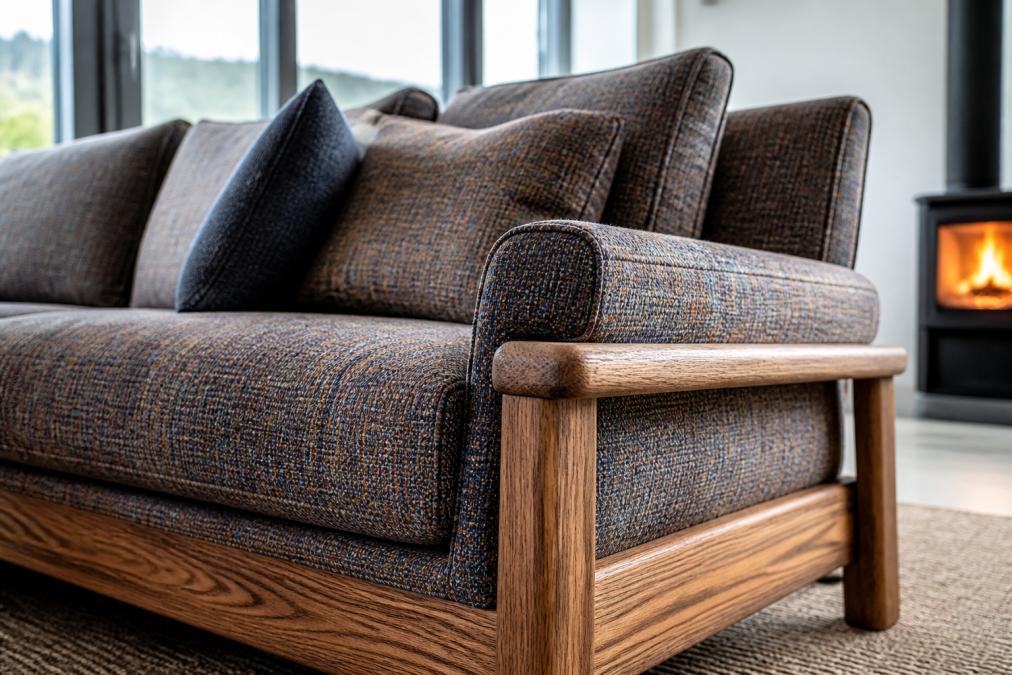
What sets it apart is the upholstery itself. Harris Tweed is a protected cloth, woven in the Outer Hebrides, and it wears in rather than out (legislation.gov.uk). Hand-tufted detailing gives the back and arms structure that cheaper foam-backed sofas lose within a couple of years.
The honest drawback is price. This is an investment piece, and the wool-rich cloth needs occasional brushing rather than a quick wipe. For anyone weighing long-term value, the cost spread across years of daily use can be favourable.
Wool-rich tweed sheds loose fibres for the first few weeks. Vacuum with a brush attachment, never a beater bar, and the surface settles into a dense, even pile.
Sofa.com The Bluebell Sofa: Customisable Comfort
If your priority is getting the exact fabric you have in mind, the Bluebell is hard to beat. Sofa.com offers over 100 fabrics and a choice of wooden or metal leg finishes, all built on a hand-built frame carrying a lifetime guarantee.
The fillings combine foam and fibre, which gives a firmer sit than a feather-wrapped seat. That suits households where the sofa doubles as a reading chair rather than a nap zone. The trade-off is real: lead times stretch depending on which cloth you select, and a popular fabric can add weeks to delivery.
For a first handcrafted purchase, the frame guarantee does a lot of reassuring. What most buyers miss is that the guarantee covers the frame, not the covers, so a pale linen in a busy household is still your risk to manage.
Loaf The Slowcoach Sofa: Relaxed Modern Living
The Slowcoach is built for slouching. Solid beech frames, hand-turned feet and deep feather-wrapped seat cushions give it a low, generous sit that suits open-plan living rooms and film nights.
Those same feather cushions are the catch. They need plumping most weeks to hold their shape, and anyone who wants a sofa that looks identical every morning should look elsewhere. The removable covers are the saving grace: spills and pet hair come out in the wash rather than becoming permanent.
The fabric choice matters more than usual here, because a slouchy silhouette shows wear faster in a light, loose weave.
Ercol Romana Sofa: Mid-Century Craftsmanship
Ercol’s steam-bent oak frame is the reason to buy this sofa. The technique, which shapes solid timber over steam rather than cutting it to curve, produces joints and arms that no flat-pack equivalent can match, and the hand-finished surfaces age into a warm patina.
The Romana’s compact footprint makes it the best option for smaller modern rooms where a deep, bulky sofa would dominate. Upholstery is tailored in the UK and the seat is designed with proper lumbar support rather than a decorative back.
The limitation is choice. Compared with modular brands, the Romana offers fewer upholstery options, so if you have a specific colour palette in mind, confirm availability before committing. It is worth it only if you value the timber work as much as the comfort.
John Lewis Croft Collection: Accessible Handcrafted Quality
The Croft Collection is the sensible entry point. Frames are solid hardwood, hand-crafted in the UK, and covered by a ten-year guarantee, with a wide selection of fabric grades to choose from.
Build quality is reliable and the customer support behind it is genuinely good.
What you give up is individuality. The designs are standardised, so you get excellent construction without the bespoke dimensions or unusual configurations that a specialist retailer can arrange. For a first handcrafted sofa in a modern home, that is a fair trade.
How to Choose a High-Quality Sofa: Frames, Fillings, and Fabric
Judging quality takes about five minutes if you know where to look. Start underneath: a hardwood frame in beech, oak or birch, joined with dowels, screws or mortise-and-tenon joints, will outlast a softwood or particleboard frame every time. Ask specifically which species and which joint, “hardwood” alone tells you nothing, because a screwed-and-glued softwood frame can legally be called hardwood if the timber is a deciduous species.
Cushion density and filling decide how the seat feels in year five, not year one:
- Foam-filled: firmest, holds shape longest, best for daily use and bad backs. Look for a high-density foam, a high-density foam is recommended for a seat that will not collapse under daily use.
- Feather-wrapped: softest, needs regular plumping, best for lounging. A feather wrap over a foam core gives the sink of pure feather without the weekly reshaping.
- Fibre: lightest and cheapest, flattens fastest, best for occasional-use rooms.
Fabric durability is measured by the Martindale test, which counts rubs before a cloth shows wear. The test is standardised under BS EN ISO 12947, so any retailer quoting a figure should be quoting to the same method (iso.org). As a working guide:
- Domestic light use (bedroom, occasional chair): around 10,000-15,000 rubs
- General domestic use (living room, adults only): 20,000-25,000 rubs
- High-traffic family homes with children or pets: 30,000 rubs and above, ideally a tight weave or a performance-treated cloth
- Contract-grade (hotels, offices): 40,000 rubs and above
Also check the textile composition, because a small synthetic percentage often improves resistance to stretching and fading. Wool and tweed wear in rather than out, but a loose weave in a pale colour will show soiling long before it shows abrasion, rub count tells you about wear, not about staining.
Seat depth decides comfort more than any other measurement, and it is where most guides stop short. A depth of around 55cm to 60cm suits upright sitting and supports the spine; anything past 65cm encourages slouching and forces the lower back into a rounded position (PubMed). If anyone in the household has back trouble, prioritise lumbar support over a deep, low seat, and check the seat height too, roughly 45cm to 48cm from floor to top of cushion lets most adults rise without pushing off the arms.
Cost per use is the calculation that reframes the whole purchase. The handcrafted piece is often the greener choice, and on a like-for-like daily-use basis it can be the cheaper one.
Measuring your space properly is the step most buyers rush. Allow at least 40cm of walkway around the sofa, measure doorways and stair turns before ordering, and tape the footprint on the floor to see how it actually sits in the room. Remember to measure the diagonal depth of the sofa against the narrowest point of the delivery route, a sofa that fits the room but not the stairwell is a common and expensive mistake.
Never judge a sofa by sitting on the showroom model alone. Ask what the cushion density is, how the frame is joined, and what the Martindale rub count is on the exact fabric you are ordering. A soft showroom seat often means a filling that will flatten within two years.
If you cannot get a rub count from the retailer, ask for the fabric’s composition and weave instead. A tight, dense weave with a small synthetic content will almost always outperform a loose natural weave in a busy household, whatever the marketing copy says.
Traditional Chesterfield Sofas in Modern Homes
Traditional chesterfield sofas have a reputation problem: people picture a heavy, buttoned monster that swallows a room. In practice, a well-made chesterfield in a modern fabric or a neutral leather is one of the most versatile pieces you can own.
The rolled arms and deep buttoning are the signature, but the proportions are what matter. A slimmer chesterfield on turned or metal legs reads contemporary rather than clubby, and pairing it with a light, textured cloth softens the formality. Where most guides go wrong is treating the chesterfield as a period piece; it works best as the single traditional element in an otherwise modern room.
The circularity argument. A handcrafted chesterfield is one of the few pieces of furniture in a modern home that can realistically outlive its first owner. The frame is hardwood, the buttoning is done by hand, and the whole thing can be stripped, refilled and re-covered decades later rather than replaced. That reupholstery potential is the circularity case for handcrafted furniture: a good frame can take two or three coverings over its life, while a glued particleboard sofa goes to landfill the moment the cushions collapse.
What reupholstery actually involves. A full re-cover of a three-seat chesterfield typically means stripping the old fabric, replacing the webbing or springs if needed, renewing the seat fillings, and re-buttoning the back and arms by hand. The buttoning is the labour-intensive part, a deep-buttoned back can carry dozens of individual buttons, each tied through the frame. That is why reupholstery quotes vary so widely, and why a plain-backed or loosely buttoned design is cheaper to restore than a fully buttoned one.
The economics. Re-covering an existing hardwood frame can be more cost-effective than buying new, as you are paying for labour and fabric rather than a new frame, new springs and new fillings. Over a long horizon, a handcrafted chesterfield that is re-covered once can work out cheaper per year than replacing a mass-market sofa multiple times, and it keeps a piece of skilled work in circulation rather than in a skip.
What to check before you buy one.
- Confirm the frame is hardwood and that the joints are mechanical, not just glued, a frame that can be stripped and re-covered needs to survive the process.
- Ask whether the seat platform uses coil springs or webbing, and whether either can be replaced independently of the frame.
- Check that the fillings are accessible, because a seat that cannot be opened and refilled cannot be restored.
- Ask the retailer whether they offer a reupholstery service, or can recommend one, before you commit.
A handcrafted chesterfield is not just a style choice, it is one of the few sofas you can genuinely hand on, re-cover and keep in use for decades. If long-term value and lower waste matter to you, it is the strongest case in this guide for buying handcrafted over mass-produced.
What Matters Most Before You Buy
- Confirm the frame material and joinery method, not just “hardwood”
- Ask for the Martindale rub count on any fabric you are considering
- Test seat depth against how you actually sit, not how the showroom looks
- Check the guarantee covers the frame, and ask what happens to covers
- Measure doorways, stair turns and walkway clearance before ordering
- Ask whether the frame can be reupholstered later
- Confirm lead time for your specific fabric choice
Frequently Asked Questions
Who makes the highest quality sofas in the UK?
Brands like Tetrad, Ercol, and Sofa.com are known for high-quality handcrafted sofas. Look for solid hardwood frames, traditional joinery, and sprung seats. Tetrad, for example, uses hand-tufted detailing and Harris Tweed upholstery, while Ercol is known for steam-bent oak frames. Always check the frame guarantee and the density of cushion fillings to gauge longevity.
What are the benefits of choosing a handcrafted sofa over mass-produced furniture?
Handcrafted sofas typically use solid hardwood frames and traditional joinery, which last decades longer than particleboard frames. They offer better ergonomic support through sprung seats and high-density foam, and can be customised with bespoke dimensions and fabrics. While the upfront cost can be higher, the cost-per-use over many years can be lower than replacing a mass-produced sofa every few years.
How do I identify a high-quality handcrafted sofa?
Check the frame: it should be solid hardwood, not plywood or particleboard. Look for joinery methods like dowels or mortise-and-tenon, not just staples. Sit on it: sprung seats should feel supportive, not saggy. Ask about cushion density (foam should be high-density) and fabric durability (Martindale test of 20,000+ rubs for general use). Finally, ask about the frame guarantee, which should be at least 10 years.
What is the difference between a bespoke sofa and a standard handcrafted sofa?
A standard handcrafted sofa is made with care but comes in fixed dimensions and a limited fabric range. A bespoke sofa is made to your exact specifications: you choose the dimensions, seat depth, cushion firmness, fabric, and leg finish. Bespoke British made sofas often have longer lead times but ensure a perfect fit for your space and style.
Why is British-made furniture considered superior in quality?
British furniture makers often use time-honoured techniques like hand-tufting, sprung seats, and traditional joinery. Brands like Tetrad and Ercol have decades of craftsmanship behind them, and many offer frame guarantees of 10 years or more. The focus on sustainable sourcing and durable construction means these pieces are built to last, making them a sound investment for modern homes.
Choosing a handcrafted sofa is a decision you live with daily for years, and the gap between a well-made piece and a good-looking one only becomes obvious after the second winter. At Artisan Sofas, we stock the Tetrad range and guide you through every fabric, leather and configuration before you commit, with white glove delivery that positions the sofa properly in your room rather than leaving it on the pavement. Explore the collection and find the piece that fits your home.
