
Blog
Why Traditional Joinery Matters for Sofa Longevity: A Buyer’s Guide
Nov
Last Updated: November 12, 2026
Quick Summary
Traditional joinery matters for sofa longevity because it locks solid timber together with shaped joints, glue and dowels, spreading load across the whole frame rather than concentrating it on a few fixings. Stapled frames can slowly work loose under repeated stress, while well-made joints hold their shape for longer.
- Mortise-and-tenon joints resist pulling apart and twisting, making them the strongest of the three main joints.
- Glued and dowelled joints spread force over a larger bonded area than staples, which pinch fibres instead.
- Ask whether the frame is solid hardwood and kiln-dried, since undried timber shrinks and pulls joints apart.
- Rock the sofa gently: a solid frame barely moves, while creaking points to weak joints.
- Act at the first creak, because a joint re-glued early is far easier to repair than one that has worn oval.
Table of Contents
- What Traditional Joinery Is and How It Works in a Sofa Frame
- Mortise-and-Tenon, Dowel and Corner Joints: The Joints That Carry the Load
- Sofa Frame Materials: Solid Hardwood, Timber Selection and Moisture
- Wood Movement, Humidity and Why Joints Loosen Over Time
- How to Choose a Durable Sofa: An Inspection Guide for Buyers
- Stress Points, Repair and Maintenance: Keeping a Traditional Frame Sound
- Booking Your Tetrad Sofa: Taking the Next Step
- Frequently Asked Questions
What Traditional Joinery Is and How It Works in a Sofa Frame
Traditional joinery is the practice of joining pieces of timber together without relying on staples, nails or screws alone. Instead, craftspeople cut shapes into one piece of wood that fit precisely into another. The joint holds because the wood itself locks together. This is the foundation of a well-built sofa frame, and it is why many buyers in the UK look for it when they shop for a lasting piece.
Tetrad sofas are built on this principle. The frame is the skeleton of the sofa, and it carries every bit of weight placed on it, from the cushions to the people who sit down, year after year.
Here is what makes joinery different from simple fixing:
- Shaped joints grip the wood on several faces, not just one point.
- Glue fills the gaps and bonds the timber fibres together.
- Mechanical support such as dowels or corner blocks adds strength where the stress is highest.
Put together, these features spread load across the whole frame instead of concentrating it on a few fixings.
Mortise-and-Tenon, Dowel and Corner Joints: The Joints That Carry the Load
Three joints do most of the work in a traditional sofa frame.
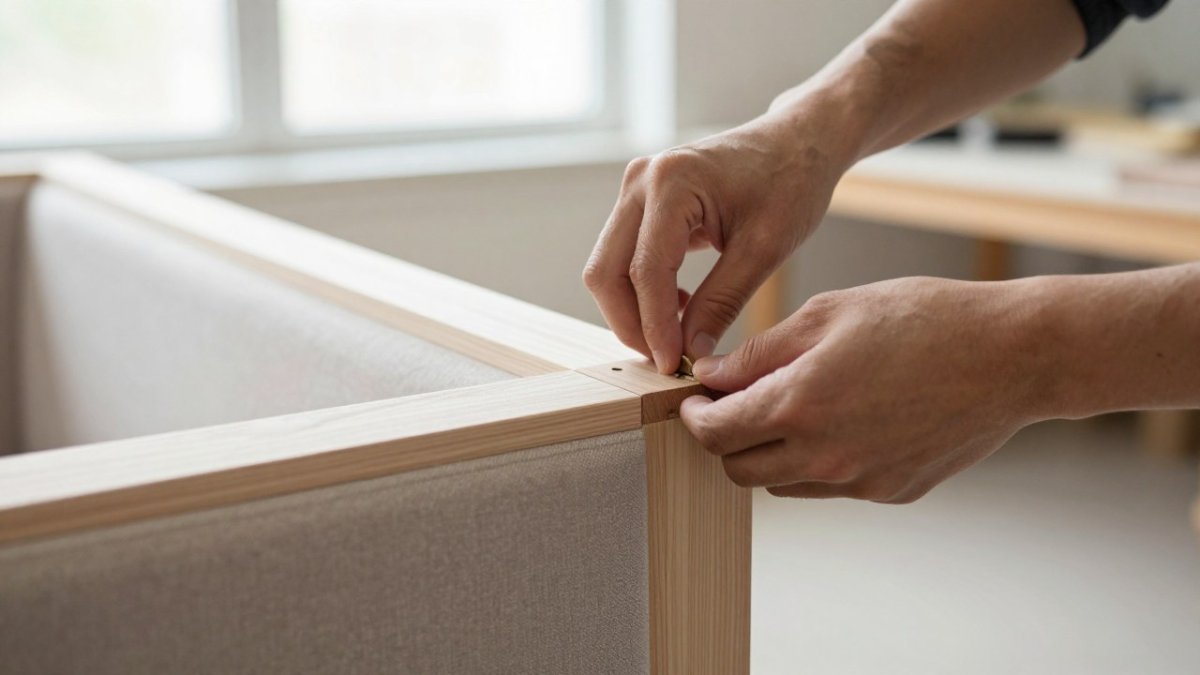
The mortise-and-tenon joint is the strongest of the three. A tenon, a tongue cut on the end of one timber, slides into a matching hole called a mortise in another. Once glued, the joint resists pulling apart and twisting. Watch out: in a cheap frame the mortise is often too loose, so the tenon rattles inside it, and that movement is what breaks the glue bond over time.
The dowel joint uses short cylinders of hardwood set into drilled holes on each side of the join. Dowels align the pieces and add shear strength. They work well for the rails that connect the front and back of a frame.
The corner joint is where the side and front rails meet. Corner blocks, glued and often screwed into the inside angle, stop the corner from racking into a parallelogram shape when someone leans on an arm.
Each joint is only as good as the way it was cut and assembled, which is why it pays to ask about them rather than assume.
Why Glued and Dowelled Joints Outlast Stapled Ones
Staples are fast and cheap, but they work by pinching fibres rather than locking them. Under repeated stress a stapled corner can slowly work loose, and a staple cannot be tightened. A glued and dowelled joint spreads force across a larger bonded area, so it tends to hold its shape for longer.
The three joints that do most of the work in a traditional sofa frame differ in how they hold and where they are used.
| Joint | Where it is used | Key strength |
|---|---|---|
| Mortise-and-tenon | Main frame connections | Resists pulling apart and twisting |
| Dowel | Rails connecting front and back | Aligns pieces and adds shear strength |
| Corner block | Side and front rail corners | Stops corners racking into a parallelogram |
Sofa Frame Materials: Solid Hardwood, Timber Selection and Moisture
The material matters as much as the joint. Solid hardwood, such as beech or ash, is widely used for traditional frames because it is dense, stiff and holds fixings well. Softwoods can be cheaper but dent more easily and are less forgiving under load. Read why solid wood sofa frames outperform engineered alternatives in durability and longevity.
Good timber selection also means looking at moisture content. Wood that is not properly kiln-dried will shrink as it dries out in a warm living room, and that shrinkage can pull joints apart. Kiln-drying takes the timber to a stable moisture level before it is worked, which reduces this risk.
When you assess a frame, ask:
- Is the frame solid hardwood, or engineered board?
- Has the timber been kiln-dried?
- Are the joints glued and dowelled, or simply stapled?
If the answers are vague, treat that as a warning sign.
Wood Movement, Humidity and Why Joints Loosen Over Time
Wood is hygroscopic: it takes in and gives out moisture from the air, and its dimensions change as it does. In a heated home, relative humidity can change considerably between seasons. Timber responds to those swings across the grain far more than along it, so a rail can swell or shrink by a small but meaningful amount over the course of a year.
The mechanism of failure is worth understanding because it explains why a sofa that felt solid in the showroom can develop a creak years later. When a tenon shrinks inside its mortise, the glue line is put under shear stress. Because these small shifts can be difficult to spot before they become audible, checking how a frame is joined alongside other signs of careful construction can help buyers judge a sofa more confidently, as House Of Moseley illustrates.
A common pattern is that joints fail in stages rather than all at once:
- Stage one: a faint creak or tick when weight shifts, often at the front corners.
- Stage two: visible movement when you rock the frame gently by hand.
- Stage three: a gap opens at the joint shoulder, and the glue line becomes visible.
- Stage four: the joint racks, the sofa no longer sits square, and upholstery starts to pull.
Catching a joint at stage one or two usually means a simple re-glue. By stage four, the timber may have worn oval inside the mortise, and the repair is more involved.
Several conditions accelerate this cycle. Direct heat from a radiator or wood burner dries the timber on one side only, creating uneven shrinkage. A sofa pushed tight against a damp external wall can absorb moisture through the back rail. Storing a frame in an unheated garage or conservatory before delivery, then bringing it into a warm room, causes a rapid moisture change that is harder on joints than gradual seasonal drift.
How to Choose a Durable Sofa: An Inspection Guide for Buyers
Before buying, you can check a frame yourself. This does not require special tools, only a bit of patience.
- Rock the sofa gently. A solid frame barely moves. Excessive creaking or rocking points to weak joints.
- Look at the corners. Check for corner blocks, glue lines and tidy joins rather than exposed staples.
- Lift one end. Feel whether the frame flexes more than it should.
- Ask about the timber. Confirm it is solid hardwood and kiln-dried.
- Check the springs and cushions too. A good frame paired with poor suspension still wears out fast.
If a retailer cannot explain how the frame is built, that is useful information in itself. Use this guide to spot signs of high quality sofa construction in suspension, cushions and stitching before you buy.
Stress Points, Repair and Maintenance: Keeping a Traditional Frame Sound
A sofa frame does not experience stress evenly. The forces concentrate at a handful of points, and knowing where they are tells you what to check and when to act.
The front corners take the highest load because that is where people sit down heavily and push up from. The joint between the front rail and the side rail is also where the arm meets the seat, so it carries both vertical weight and the sideways racking force from leaning. The back corners see less downward load but more twisting, especially on a sofa where people lean back.
You can test these points yourself without tools:
- The corner test. Stand at one end of the sofa and gently rock the frame side to side. A sound frame moves as one unit. A loose corner will show a small delay or a creak before the rest of the frame follows.
- The leg test. Lift one leg a few centimetres and let it drop gently. Listen for a rattle or thud that suggests the leg joint is working.
- The seat-support test. Press down firmly on the centre of the seat. If the support flexes more than the surrounding frame, the webbing or rails may be stretching.
- The square test. Measure diagonally from corner to corner across the frame. On a square frame the two measurements should match closely. A difference of more than a few millimetres suggests the frame has racked.
If you find a loose joint, repair is often feasible and worth doing early. A skilled upholsterer can usually access a corner joint by lifting the upholstery at the base, clean out the old glue, inject fresh glue, and clamp the joint while it sets.
Watch out: do not simply drive a longer screw through a loose joint. It can split the timber and makes a proper repair harder later.
Prevention is mostly about load and movement. Avoid dragging the sofa, because dragging twists the frame in a way it was never designed to resist. Rotate and flip cushions so the seat supports wear evenly. Keep the sofa away from direct heat and damp walls, as covered above.
Booking Your Tetrad Sofa: Taking the Next Step
Choosing a sofa built on traditional joinery is a decision you will live with for years, so it is worth taking your time. Use the inspection checks above, ask about the frame and the timber, and compare how each piece feels when you sit on it.
When you are ready, explore the Tetrad range and look at the traditional chair and sofa options that suit your room. You can also browse the Tetrad chairs collection if you are furnishing a whole living space. Our team can guide you through fabrics and leathers, so you can book with confidence.
Frequently Asked Questions
What is traditional joinery in a sofa frame?
Traditional joinery is the practice of connecting frame members with cut joints such as mortise-and-tenon, dowel and corner joints, often reinforced with glue, rather than relying only on staples or screws. The joint shape spreads load across a larger glued surface, so the frame resists racking when people sit, lean and push on the arms. Tetrad frames are built this way, which is why the joints hold their shape over many years of use rather than loosening at the first point of stress.
Why does sofa frame construction affect how long a sofa lasts?
The frame carries the weight of the seat, back and arms every day, and its joints take repeated stress each time someone sits down or shifts position. When joints are well cut and glued, the frame stays square and the upholstery sits evenly for longer. Weak or poorly fixed joints are usually the first thing to fail, after which the sofa sags, creaks and wobbles. Frame construction therefore sets the practical lifespan of the piece more than the fabric does.
Are dowelled and glued sofa joints stronger than stapled joints?
A dowelled and glued joint generally resists movement better than a stapled joint, because the glue bonds the full contact surface and the dowel keeps the parts aligned under load. Staples grip only a small area of timber and can work loose as the wood moves with changes in humidity and temperature. This is a general construction principle rather than a measured figure, so the best check is to ask the retailer how a frame is jointed and to test it by hand on the showroom sofa.
How can you tell if a sofa has a well-made frame?
Start by asking what the frame is made from and how its joints are constructed, and look for solid hardwood and visible, tightly fitted corner joints. Press firmly on the arms and back and watch for flex, squeaks or movement between members. Check that the frame feels rigid rather than springy, and that the seat base is supported evenly. A sofa that passes these simple tests is more likely to keep its shape over time, though a showroom check cannot confirm long-term performance.

