
Blog
How to Prevent Leather Sofa Cushions from Sagging: Practical Fixes
Nov
Last Updated: November 2, 2026
Quick Summary
Leather sofa cushions sag because the filling compresses under repeated use, not because of the leather itself. You can slow this by rotating removable cushions every three to six months, plumping them gently by hand, and checking whether the problem lies in the fill, frame, or suspension.
- Rotate removable cushions every three to six months to spread out wear.
- Plump cushions by hand, holding them by the sides rather than the leather seams.
- Press the cushion firmly; slow springback points to worn fill.
- A wobbling or bowed base indicates frame or suspension problems that refilling won’t fix.
- Try reversible fixes like support boards first before committing to permanent repairs.
Table of Contents
- Why Leather Sofa Cushions Sag in the First Place
- Diagnosing Cushion Fill Versus Frame and Suspension Problems
- How Often to Rotate Sofa Cushions for Even Wear
- How to Plump Sofa Cushions Without Damaging the Leather
- Leather Sofa Cushion Refilling: Choosing and Comparing Fill Materials
- How to Fix Sagging Sofa Cushions: Reversible Fixes Versus Permanent Repairs
- Booking Your Next Step: Care Routine or Professional Repair
- Frequently Asked Questions
Why Leather Sofa Cushions Sag in the First Place
Leather sofa cushions sag for one simple reason: the filling gets tired. Foam and fibre compress under the same spot, day after day, until the seat no longer springs back. No sofa is immune to daily use.
Most sagging comes from uneven use. One person always sits in the same corner, and the cushion in that spot wears faster than the rest. Heavy use also flattens the top layer of foam first, then the layers beneath it.
Here’s the part most people miss. Leather itself rarely causes sagging. The cushion inside does. Once you understand that, the fix becomes much clearer.
Diagnosing Cushion Fill Versus Frame and Suspension Problems
Before you buy new filling, check what’s actually wrong. A sagging seat can come from three places: the cushion fill, the frame, or the suspension underneath.
Run this quick check:
- Press the cushion firmly with your palm. If it springs back slowly, the fill is worn.
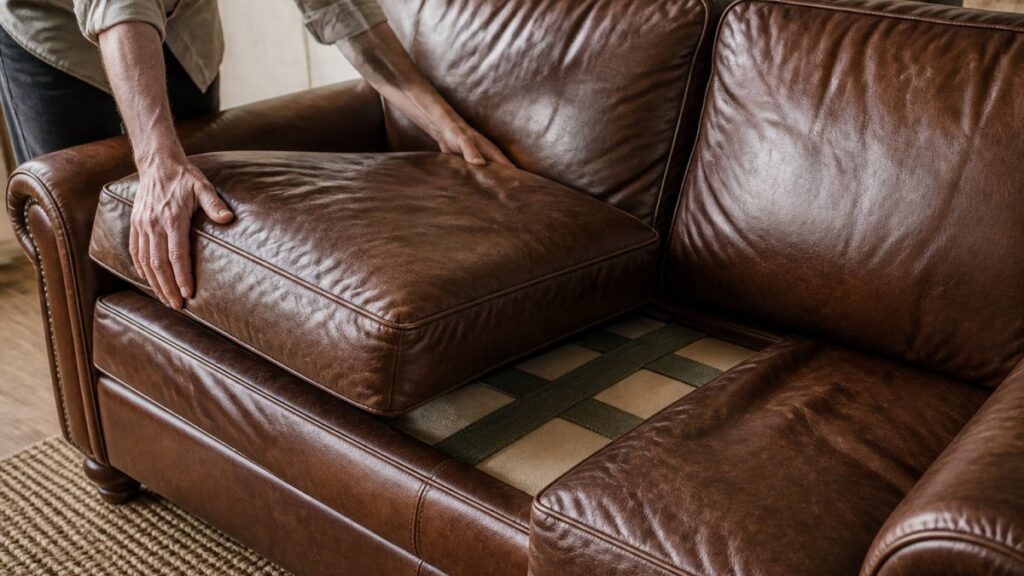
- Lift the cushion off and look at the base. Sagging webbing or a bowed board points to the suspension. Learn what quality sofa frame construction looks like.
- Feel for hard spots or wobbling. A loose or cracked frame often feels unstable, not just soft.
- Sit in different spots. If only one area dips, the problem is usually local wear.
Watch out: Refilling cushions won’t fix a broken frame. Learn how long Tetrad sofas should last and what maintenance to expect. If the base feels unstable, get it inspected before you spend money on new foam.
How Often to Rotate Sofa Cushions for Even Wear
For most households, rotating cushions every three to six months keeps wear even. Flip the seat cushions side to side, and swap the back cushions so the most-used one moves to a quieter spot.
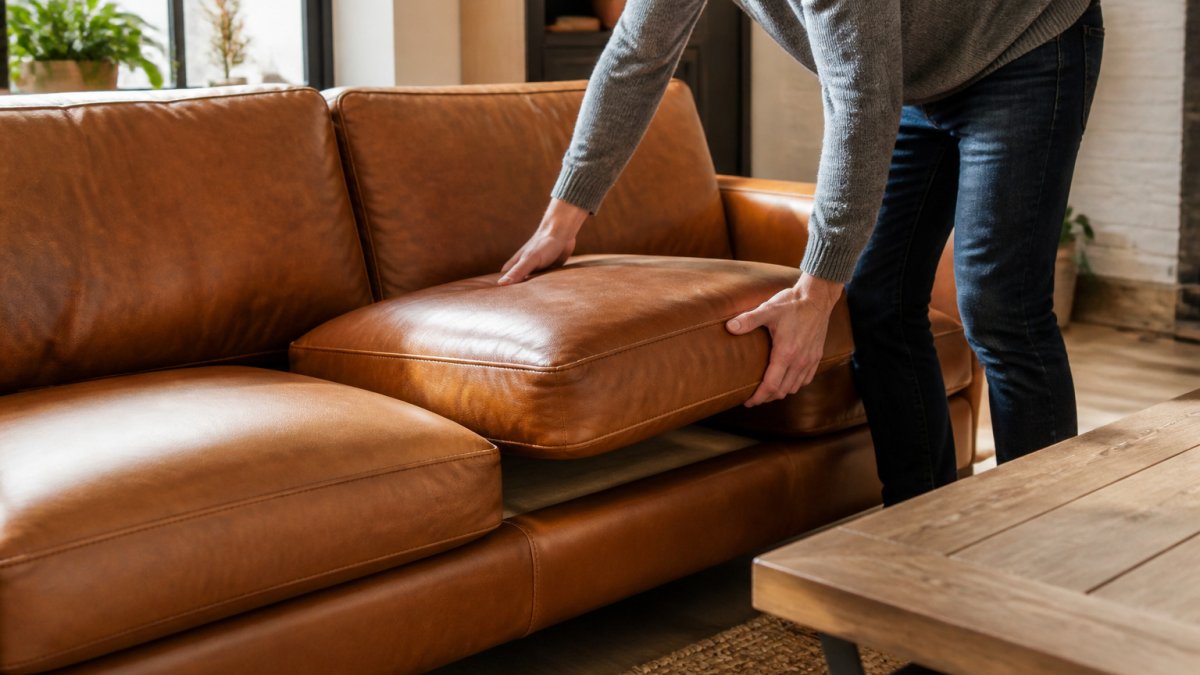
Rotation only works on removable cushions. Sewn-in cushions can’t be moved, so you’ll need to focus on shared sitting habits instead.
Try to spread use across the whole sofa. Ask everyone to sit in different spots, and avoid perching on one arm every evening.
How to Plump Sofa Cushions Without Damaging the Leather
Plumping helps restore loft to a compressed cushion. Find the proper cleaning and conditioning routine for leather. It works best on loose-fill or foam-filled cushions with removable covers.
- Remove the cushion and set it on a clean, flat surface.
- Hold it by the sides, not the leather seams.
- Press the cushion gently with both hands to loosen the fill.
- Shape the corners and edges by hand, working slowly.
- Return the cushion and sit on it briefly to settle the fill.
Avoid pounding or twisting the cushion. Leather can stretch, crease, or tear under rough handling. Work gently and use your hands, not tools.
Leather Sofa Cushion Refilling: Choosing and Comparing Fill Materials
Refilling makes sense when plumping no longer restores the shape. The fill you choose affects comfort, durability, and how the sofa feels for years, so compare options on firmness, how they age, and whether they suit a leather cover.
Foam inserts. Foam gives a structured, supportive seat and holds its shape longer than fibre. Firmness is usually described by density and grade: higher-density foam feels firmer and resists compression better, while lower-density foam feels softer but flattens sooner. A common pattern is to match the foam to how the sofa is used, a firmer grade for a main family seat, a softer grade for occasional seating.
Fibre fill. Fibre is soft, springy, and light, and it gives a looser, more relaxed seat. It flattens faster under heavy or concentrated use and needs plumping more often. Fibre suits back cushions and seats where a soft, sink-in feel matters more than long-term support.
Combination fill. A foam core wrapped in fibre balances support and softness: the foam holds the shape while the fibre adds surface comfort. This is often the best compromise for leather sofas, where the cover has little give and a firm base helps the hide sit smoothly. Because a well-supported cushion helps leather retain a smooth shape, the same attention to gentle care can help maintain leather poufs without compromising their supple surface.
Support inserts and boards. A firm foam board or a purpose-made support insert placed beneath the cushion can restore height without a full refill. These are best treated as a reversible fix, see the next section for how they compare with permanent repairs.
When refilling, handle the leather carefully. Open the cover along existing seams rather than cutting new ones, avoid stretching the hide, and support the cover while you slide the new fill in. Close the cover without pulling it tight, and let the leather settle before judging the fit.
Watch out: A refill will not compensate for worn suspension or a bowed base. If the seat still dips after refilling, the problem is beneath the cushion, not inside it.
How to Fix Sagging Sofa Cushions: Reversible Fixes Versus Permanent Repairs
Some fixes can be undone. Others are permanent. The right choice depends on what the diagnosis showed, how long you plan to keep the sofa, and how much you are willing to change the leather cover.
Reversible fixes can be removed or undone without altering the sofa permanently:
- Add a firm foam board or support insert beneath the cushion to restore height.
- Place a thin cushion topper for extra loft.
- Rotate and plump cushions regularly to even out wear.
- Swap cushions between seats where sizes allow.
These suit a sofa you may sell or move, a rental, or a piece you are not ready to commit to repairing. They are also the sensible first step: try the reversible option, live with it for a few weeks, and see whether the seat holds.
Permanent repairs change the sofa and are usually best done by an upholsterer:
- Replace the foam core entirely.
- Re-stitch or re-upholster a sewn-in cushion.
- Reinforce or replace the suspension, such as webbing or springs.
- Repair or replace a damaged frame.
These suit a piece you plan to keep for decades, or one where the diagnosis points to failed suspension or a damaged frame rather than tired fill. Permanent repairs may require the leather cover to be opened along seams, so choose an upholsterer experienced with leather.
A simple way to decide: if the cushion springs back slowly but the base feels solid, start reversible. If the base feels unstable, bowed, or the frame wobbles, skip the reversible fixes and get the suspension or frame inspected, adding support in the wrong place can mask the real problem and make it worse.
Watch out: Reversible support boards and inserts must be sized to sit flat within the cushion area, with no sharp edges and enough ventilation so the leather and fill do not trap damp. An ill-fitting board can crease the leather or damage the cover.
The article separates fixes you can undo from permanent repairs, so the options are easy to compare.
| Fix | Type | Best for |
|---|---|---|
| Firm foam board or support insert | Reversible | Restoring height without a full refill |
| Thin cushion topper | Reversible | Extra loft |
| Rotating and plumping cushions | Reversible | Evening out wear |
| Swapping cushions between seats | Reversible | Where sizes allow |
| Replacing the foam core | Permanent | Long-term repair by an upholsterer |
| Re-stitching or re-upholstering a sewn-in cushion | Permanent | Sewn-in cushions |
| Reinforcing or replacing suspension | Permanent | Failed webbing or springs |
| Repairing or replacing a damaged frame | Permanent | Loose or cracked frames |
Booking Your Next Step: Care Routine or Professional Repair
If the cushions only need plumping and rotation, a simple care routine will keep your sofa in good shape. Build in a check every few months, and treat the leather gently.
If the frame feels loose, the suspension has failed, or the fill is badly compressed, a professional repair is the safer choice. Learn how to verify authentic Tetrad furniture before booking work. Check your sofa’s make and any warranty that applies before you book any work. See what the manufacturer’s warranty covers.
Frequently Asked Questions
Why do leather sofa cushions sag?
Leather sofa cushions usually sag because the filling compresses over time, most often where people sit most. Uneven use concentrates pressure on one seat, and foam loses its resilience after years of compression. Fibre fill can clump and flatten in the same way. Rotating cushions regularly spreads the load across all of them, and checking the filling every few months lets you spot compression before the seat feels noticeably softer. Leather itself rarely causes the sag.
Can you plump up sagging leather sofa cushions?
Yes, but plumping only works when the foam or fibre still has some spring left. Remove the cushion, hold it at both ends and gently squeeze and reshape it, then leave it to rest for a few hours. Avoid pressing hard on the leather or using sharp tools near the seams. If the cushion stays flat after plumping, the filling has lost its structure and needs refilling or replacing.
How do you fix a leather sofa cushion that has lost its shape?
Start by checking whether the cushion is removable or sewn in. Removable cushions can be opened carefully and topped up with new foam or fibre, then reclosed. Fixed or sewn-in cushions are harder to repair without professional help. Whatever the method, work slowly around the leather, avoid stretching the hide, and check the frame underneath, as a weak support board can mimic cushion sag.

